
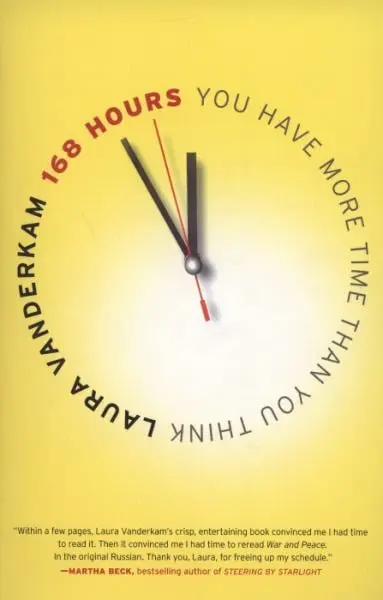
168 Hours, by Laura Vanderkam: 2000-word book summary. The central idea is simple and slightly uncomfortable: you have 168 hours every week, and you’re already choosing how to spend all of them. You don’t need more time; you need to use your time in line with what actually matters to you.
From now on I’ll follow your preferred format: each section includes a real quote from the author that fits that idea.
1. You have more time than you think
Vanderkam starts by reframing time: instead of thinking in days (“I’m busy today”), she urges us to think in weeks—168 hours. Once you subtract sleep and work, there is still a surprising amount left.
“You can choose how to spend your 168 hours, and you have more time than you think.”
~ Laura Vanderkam
Her point: the “I’m too busy” story is often a perception problem, not a mathematical one. Seeing the whole 168-hour canvas exposes how much is drifting into low-value activities.
2. The time-crunch story is wrong
Most people feel overworked and under-rested, but when you look at accurate time data, the story changes. Vanderkam argues that we misremember and misreport our hours, often overestimating work and underestimating leisure.
“When it comes to daily life, the time-crunch narrative doesn’t tell the whole story. The problem is not that we’re all overworked or underrested, it’s that most of us have absolutely no idea how we spend our 168 hours.”
~ Laura Vanderkam
We feel crushed partly because we don’t really know where our time goes—so we can’t consciously redirect it.
3. Track your 168 hours
The first practical step is a time log: track every hour of one week. Vanderkam sees this as almost non-negotiable if you want to change your life, because the log replaces stories with facts.
“To spend time better, figure out where the time goes.”
~ Laura Vanderkam
You don’t have to track forever, but even one honest week can reveal huge pockets of usable time hidden in commutes, scrolling, TV, and aimless puttering.
4. Core competencies: build your life around what you do best
A key concept: core competencies—the things you do best, enjoy, and that matter most to your life. Vanderkam wants you to identify these and load more of your week with them.
“Identify your core competencies. There are the things you do best, and that other people cannot do nearly as well… Others likely include nurturing your family members and other loved ones, and nurturing your own soul, brain, and body in ways that you excel at and enjoy.”
~ Laura Vanderkam
The test is simple: How many of your 168 hours are going to your core competencies—and how many are going to everything else?
5. “I don’t have time” really means “It’s not a priority”
Vanderkam repeatedly returns to this uncomfortable but freeing reframe: in most modern lives, time is about choice, not absolute scarcity.
“ ‘I don’t have time’ often means ‘it’s not a priority.’ ”
~ Laura Vanderkam
If you say you “don’t have time” to exercise, read, or see friends, she invites you to try saying, “It’s not a priority.” If that feels wrong, that’s the signal to change how you spend your hours.
6. Work that actually counts
She defines “work” narrowly and provocatively: not everything you do at the office counts as real work.
“I define ‘work’ as activities that are advancing you toward the career and life you want. If they aren’t, then they are not work. This is true even if they appear on your work calendar or you’ve always done them.”
~ Laura Vanderkam
Her “168 hours principle for work” is that almost nothing during your work hours should fail this test. Email, pointless meetings, and shallow tasks need to be reduced so the bulk of your effort advances your real goals.
7. Doing a lot vs doing what matters
Vanderkam warns against confusing activity with impact. A packed calendar can be a way of avoiding the hard question: Is any of this actually important?
“Doing a lot does not mean you’re doing anything important with your 168 hours.”
~ Laura Vanderkam
This is a knife-sharp filter: a week crammed with low-value busywork is still, in a very real sense, a wasted week—no matter how heroic it felt.
8. Design your ideal week on a blank slate
Instead of tweaking around the edges, Vanderkam suggests imagining your ideal 168 hours as a blank slate, then deliberately filling it with what deserves to be there—work that matters, relationships, health, learning, and real leisure.
“This is what happens when you treat your 168 hours as a blank slate. This is what happens when you fill them up only with things that deserve to be there. You build a life where you really can have it all.”
~ Laura Vanderkam
From there, you reverse-engineer reality to move your current week closer to that design.
9. There is room for career, family, and self
One of her most hopeful messages is that you don’t inherently have to choose between big work and big family or between ambition and self-care. The constraint is how you use your hours, not how many you have.
“When you focus on what you do best, on what brings you the most satisfaction, there is plenty of space for everything. You can build a big career. You can build a big family. And you can meander along a Maryland creek on a weekday morning because the day is too wild and beautiful to stay inside.”
~ Laura Vanderkam
The trade-offs are real, but often much less brutal than our default “either/or” story.
10. Outsource, automate, or ignore the rest
Once you know your core competencies, anything outside them becomes a candidate to ignore, minimize, or outsource.
“Ignore, minimize, or outsource everything else… If you keep an accurate log of your 168 hours, you will likely be surprised by the number of hours you spend on certain things.”
~ Laura Vanderkam
She also notes that if a task is truly dumb, the best “outsourcing” may be not doing it at all: some processes can be automated or simply dropped rather than delegated.
11. The right job and core-competency work
Vanderkam links time and career design. A “right job” isn’t just about money; it’s about alignment with your strengths and motivations.
“The right job leverages your core competencies—things you do best and enjoy—and meets certain working conditions, including autonomy and being challenged to the extent of your abilities.”
~ Laura Vanderkam
If your job fits this description, time feels expansive and energising; if it doesn’t, your 168 hours will always feel too small.
12. Placing many bets and stacking the odds
She encourages using your 168 hours to create opportunities rather than waiting for luck. That means trying lots of things, starting projects, and making room for attempts that might fail.
“You cannot remove randomness from the universe. You can, however, use your 168 hours to stack the odds in your favor. To do this, you have to place many bets, and leave nothing you can control to chance.”
~ Laura Vanderkam
Time becomes a portfolio of experiments that gradually tilt your life in the direction you want.
13. Trying things to discover what matters
Most people don’t fully know what they want to do with their time. Vanderkam’s solution is active exploration.
“By trying lots of things you think you might enjoy, you will learn more about yourself, and what you are actually good at, what might be your core competencies, and which of the biggies are worth going for.”
~ Laura Vanderkam
You don’t find your ideal life just by thinking about it; you prototype it with your hours.
14. The “List of 100 Dreams” and meaningful leisure
She suggests creating a “List of 100 Dreams”—things you’d like to do or experience in your life—and then pulling items into your schedule in small, doable steps.
“Create your ‘List of 100 Dreams’… A lifetime is simply 168 hours, repeated again and again, and creating a completely unedited list of anything that might be pleasurable or meaningful will help you figure out what matters to you, and hence should go in your schedule.”
~ Laura Vanderkam
Instead of defaulting to TV or scrolling, you fill “bits of time with bits of joy”: short activities that actually matter to you.
15. Bits of time, bits of joy
Vanderkam is big on micro-leisure and micro-progress: using small pockets of time intentionally, not just killing them.
“Fill bits of time with bits of joy… Make lists of things that make you happy or that you find meaningful, and that take 30 minutes or less, or even less than 10 minutes.”
~ Laura Vanderkam
Over months and years, these small deliberate uses of time compound into a radically richer life.
16. Reducing time traps
Once you see where time is leaking—mindless TV, low-value chores, pointless tasks—you can start knocking out the “easy wins” first.
“Knock a few of these easy items off first, then look for ways to minimize more complicated time traps.”
~ Laura Vanderkam
This creates quick momentum and makes it psychologically easier to tackle bigger structural changes.
17. Owning your choices
A recurring theme is radical ownership: you are in charge of how you spend your minutes. That idea can feel heavy at first, but Vanderkam sees it as freeing.
“I know I’m in charge of me. Everything that I do, every minute I spend is my choice… If I’m not spending my time wisely, I fix it.”
~ Laura Vanderkam
Once you accept that your calendar reflects your choices, you also reclaim the power to change it.
18. Nurturing career, relationships, and self
Vanderkam rejects the feeling that self-care is selfish or impossible. She sees time for yourself as part of a healthy, integrated life.
“In 168 hours, there is plenty of space to nurture yourself alongside your career and your relationships.”
~ Laura Vanderkam
The goal is not balance in a fragile, perfect sense, but a week where each of these domains gets deliberate attention.
19. Constantly minding time
She is honest that living this way isn’t a one-and-done fix. Paying attention to time is ongoing work—but it’s worth it.
“Constantly minding time is more challenging than letting it slip unnoticed into the past. It is also never done.”
~ Laura Vanderkam
The alternative, though—letting weeks disappear without thought—is far more costly in the long run.
20. The final lesson: build the life you want, then time will follow
Vanderkam’s deepest message is not about cramming more in; it’s about building a life that’s worth filling your hours with.
“You don’t build the life you want by saving time. You build the life you want, and then time saves itself.”
~ Laura Vanderkam
Once your priorities are clear and your schedule reflects them, a lot of “time management” problems quietly dissolve.
Key takeaways
- Think in weeks (168 hours), not days – it reveals how much time you really have.
- Track your time honestly to replace feelings with facts.
- Identify and protect your core competencies in work and life.
- “I don’t have time” usually means “It’s not a priority.”
- Design your week as a blank slate filled only with what deserves to be there.
- Outsource, automate, or drop non-essential tasks.
- Use bits of time for bits of joy and meaningful progress.
- Accept full ownership of how you spend your hours.
Leave a Reply
You must be logged in to post a comment.