
1558: Elizabeth I Ascends the Throne of England
On November 17, 1558, Elizabeth I ascended the English throne following the death of her half-sister, Queen Mary I. Her reign ushered in the Elizabethan Era, marked by a flourishing of English culture, exploration, and stability, and she became one of England’s most iconic monarchs.
I know I have the body of a weak, feeble woman; but I have the heart and stomach of a king.
~ Elizabeth I
Elizabeth famously declared her resolve to rule England with strength, emphasizing that her will was as formidable as any king’s.
I would rather be a beggar and single than a queen and married.
~ Elizabeth I
Elizabeth’s decision to remain unmarried throughout her reign became central to her image as the “Virgin Queen.”
A clear and innocent conscience fears nothing.
~ Elizabeth I
She often relied on her sense of justice and personal integrity as a basis for her decisions.
I do not want a husband who honours me as a queen, if he does not love me as a woman.
~ Elizabeth I
Elizabeth expressed her reluctance to marry without genuine love, despite pressures to secure an alliance.
There is only one Christ, Jesus, one faith. All else is a dispute over trifles.
~ Elizabeth I
Her religious tolerance was a defining trait, promoting stability in a time of significant religious conflict.
Though the sex to which I belong is considered weak, you will nevertheless find me a rock that bends to no wind.
~ Elizabeth I
Elizabeth proudly asserted her strength as a woman ruler in a male-dominated world.
I have no desire to make windows into men’s souls.
~ Elizabeth I
Elizabeth chose not to prosecute people for their religious beliefs, as long as they were loyal to her rule.
Where minds differ and opinions swerve there is scant a friend in that company.
~ Elizabeth I
She was cautious about advisors, recognizing the risks of divided counsel in her court.
I see, but I say nothing.
~ Elizabeth I
Known for her keen political instincts, Elizabeth often observed her advisors’ actions without immediate comment.
To be a king and wear a crown is a thing more glorious to them that see it than it is pleasant to them that bear it.
~ Elizabeth I
Elizabeth acknowledged the weight and challenges of ruling, noting that the throne was more revered than comfortable.
Unusual Facts:
- Elizabeth survived smallpox at age 29, which left her with facial scars she covered with lead-based makeup.
- She was fluent in multiple languages, including Latin, Greek, French, and Italian.
- Elizabeth maintained a secretive, intricate spy network led by Sir Francis Walsingham to protect her reign.
- She allegedly wore a locket ring containing a miniature portrait of her mother, Anne Boleyn.
- Elizabeth established the first English joint-stock company, which led to the eventual establishment of the British Empire.
1603: Death of Richard Hakluyt, English Geographer and Writer
On November 17, 1603, Richard Hakluyt, a pioneering English geographer and writer, passed away. His collections of travelers’ tales inspired English exploration and documented England’s early voyages of discovery.
The world is vast, and there lies beyond it a realm of opportunity for those who dare to venture.
~ Richard Hakluyt
Hakluyt encouraged exploration, seeing new lands as opportunities for growth and discovery.
1796: Catherine the Great of Russia Dies
On November 17, 1796, Catherine the Great, the longest-ruling female leader of Russia, passed away. Her reign brought expansion and modernization to Russia, making it a European power.
I am one of the people who love the why of things.
~ Catherine the Great
Catherine valued knowledge and inquiry, which drove her to modernize Russia.
1869: Opening of the Suez Canal
On November 17, 1869, the Suez Canal officially opened, connecting the Mediterranean Sea to the Red Sea. This engineering feat transformed global trade by reducing travel time between Europe and Asia.
The Suez Canal is more than a waterway; it is a bridge between continents, a path for cultures to meet and grow.
~ Ferdinand de Lesseps, Suez Canal architect
De Lesseps saw the canal as a link between cultures and economies, creating new possibilities for trade.
1887: Birth of Field Marshal Bernard Montgomery
On November 17, 1887, Bernard Montgomery, the British Field Marshal of World War II, was born. Known for his strategic brilliance, Montgomery was key in the Allied victory in North Africa.
Leadership is the capacity to translate vision into reality.
~ Bernard Montgomery
Montgomery believed in leadership as the art of turning plans into action.
1913: First Volume of Marcel Proust’s In Search of Lost Time Published
On November 17, 1913, Marcel Proust published Swann’s Way, the first volume of In Search of Lost Time. The novel, known for its exploration of memory, became a literary masterpiece of the 20th century.
Remembrance of things past is not necessarily the remembrance of things as they were.
~ Marcel Proust
Proust’s insight on memory suggests that recollections are often reshaped by emotions and perspectives.
1933: United States and Soviet Union Establish Diplomatic Relations
On November 17, 1933, the United States and the Soviet Union established formal diplomatic relations, marking a shift in international relations and setting the stage for a complex future relationship.
Dialogue bridges what distance divides, for diplomacy is the language of peace.
~ Franklin D. Roosevelt
Roosevelt saw diplomatic relations as essential for peace and understanding.
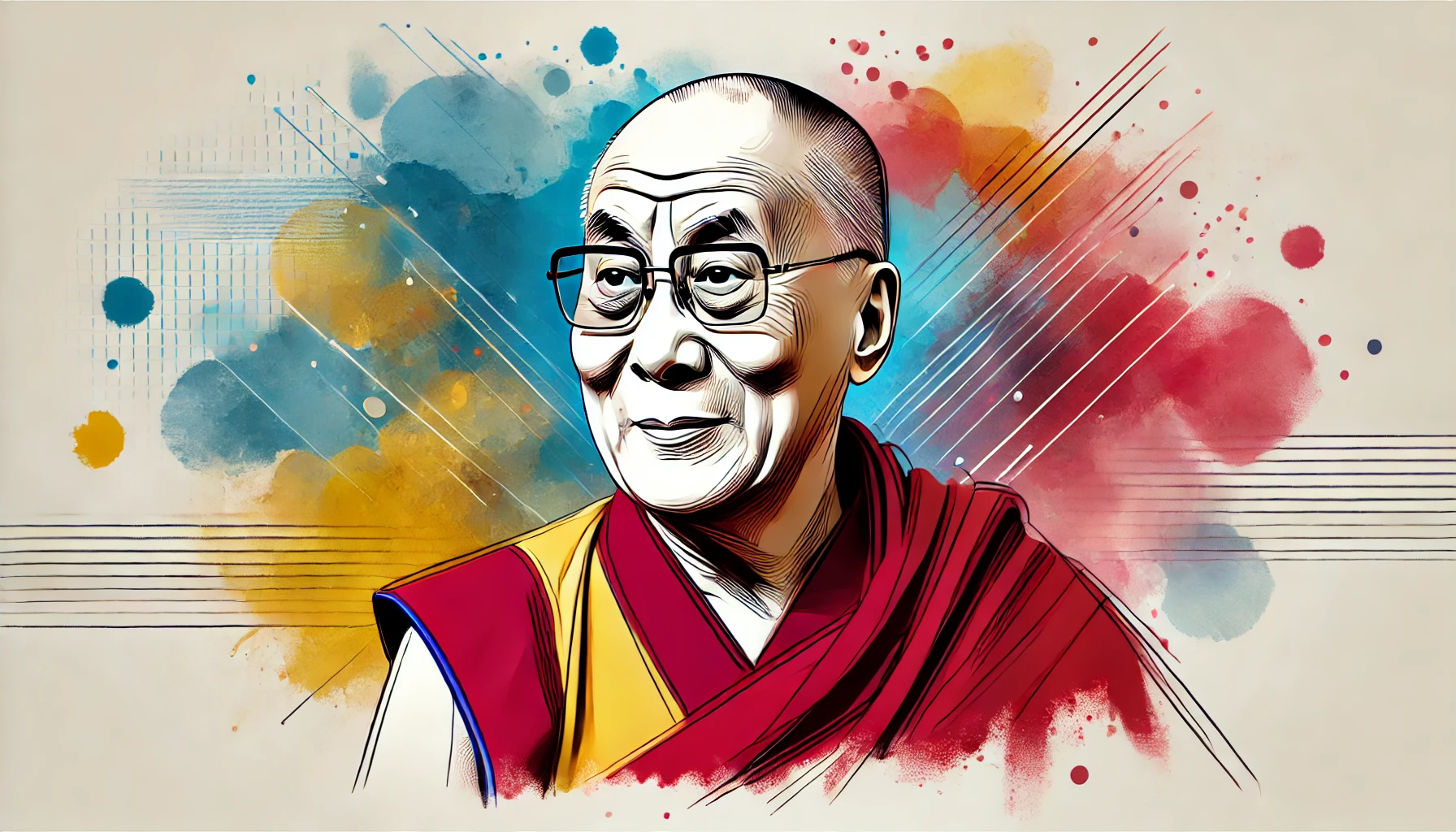
1950: Lhamo Thondup Formally Becomes the 14th Dalai Lama
On November 17, 1950, Lhamo Thondup was formally declared the 14th Dalai Lama of Tibet at age 15. He became a global figure advocating for peace, compassion, and Tibetan autonomy.
My religion is very simple. My religion is kindness.
~ Dalai Lama
The Dalai Lama’s teachings promote kindness and compassion as universal values.
1970: Douglas Engelbart Receives Patent for the Computer Mouse
On November 17, 1970, Douglas Engelbart was granted a patent for the computer mouse, revolutionizing human-computer interaction and paving the way for modern personal computing.
The simplest ideas are often the most revolutionary; with a click, we connect to a world of endless possibility.
~ Douglas Engelbart
Engelbart saw the mouse as a powerful tool for expanding digital access and innovation.
2003: Arnold Schwarzenegger Sworn in as Governor of California
On November 17, 2003, actor and former bodybuilder Arnold Schwarzenegger was sworn in as the Governor of California. His unique path to politics marked a significant shift in California’s leadership.
Strength is not just about muscles; it’s about the courage to step into the unknown and make a difference.
~ Arnold Schwarzenegger
Schwarzenegger framed strength as a trait that includes bravery and purpose beyond physical prowess.
Leave a Reply
You must be logged in to post a comment.