
Overview
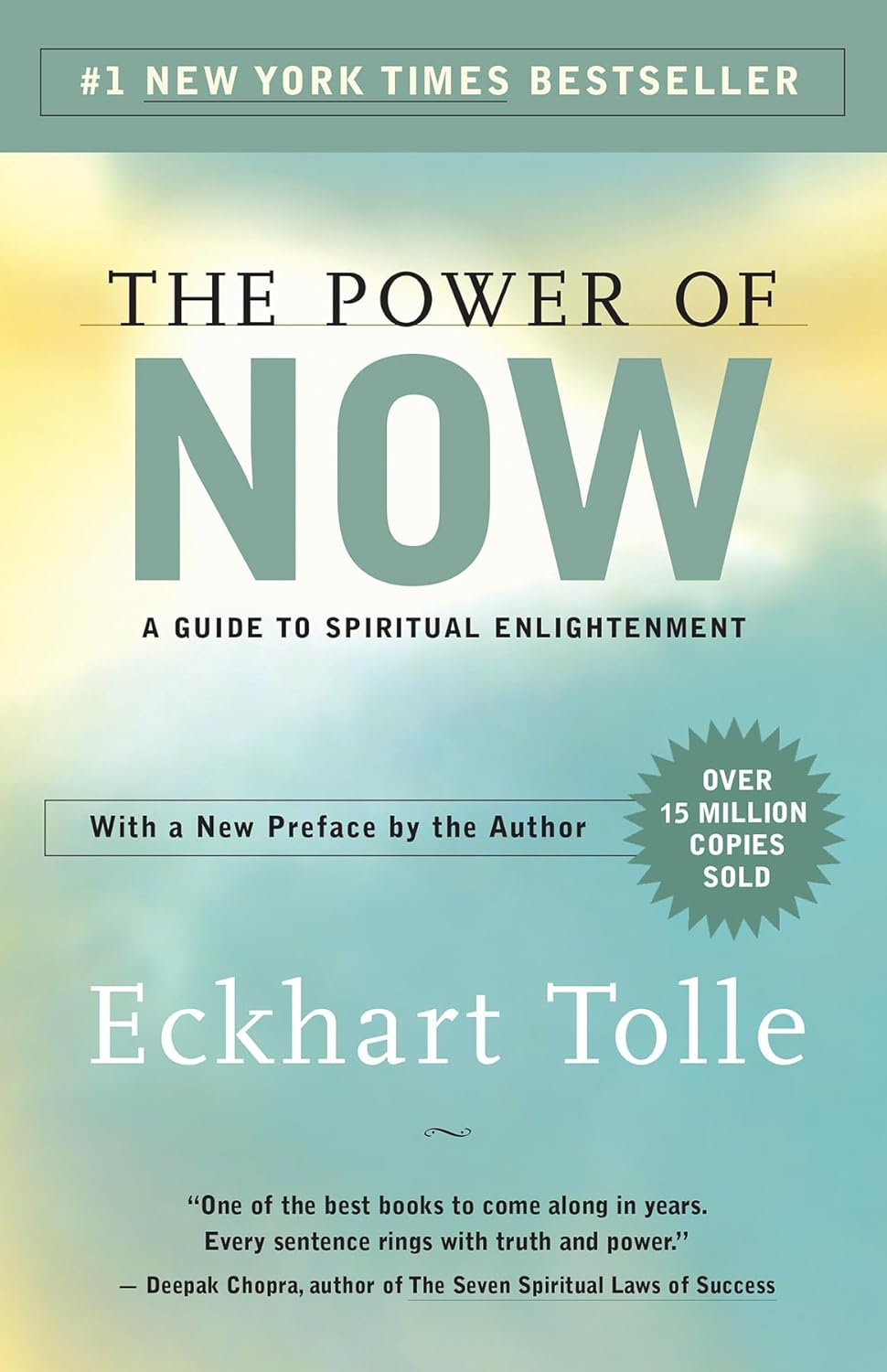
Eckhart Tolle’s The Power of Now is a spiritual guide to awakening from the trance of the mind and discovering peace in the present moment. It teaches that most human suffering comes from living in the past or the future—regretting what was or worrying about what might be. The solution, Tolle argues, is to bring awareness to the Now, the only moment that truly exists.
The book blends psychology, philosophy, and spiritual wisdom, urging us to transcend thought and discover the stillness beneath it. It’s not about escaping life but fully experiencing it, free from identification with the mind’s constant noise.
“Realize deeply that the present moment is all you ever have.”
~ Eckhart Tolle
1. Awakening to the Power of Now
Tolle begins with his own story of transformation: after years of depression and anxiety, he reached a breaking point—an inner collapse that gave rise to a profound realization: “I can no longer live with myself.” He suddenly understood there were two of him—the observing consciousness and the suffering mind—and that he was not his thoughts.
From that moment, his suffering dissolved. He lived in a state of deep peace and presence. The lesson: liberation begins when you see the difference between the thinker and the observer.
“You are not your mind. You are the awareness behind it.”
~ Eckhart Tolle
This awakening happens when you become conscious of your thoughts without judging or believing them. You start to notice the space between thoughts—and that space is the Now.
2. The Illusion of Time
Tolle distinguishes between clock time (practical time used for appointments and planning) and psychological time—the endless mental preoccupation with the past and future. The latter is the root of unhappiness.
People suffer because they live almost entirely in psychological time—reliving regrets, holding grudges, or worrying about future outcomes. This mental projection disconnects us from reality.
“Unease, anxiety, tension, stress, worry—all forms of fear—are caused by too much future, and not enough presence.”
~ Eckhart Tolle
When you drop into the present, problems dissolve. The mind may still have challenges to solve, but suffering—our emotional resistance to what is—vanishes.
3. The Mind as an Instrument—and the Source of Suffering
Tolle describes the human mind as a powerful tool that has turned against us. Instead of using thought consciously, we are used by thought. Our constant inner chatter keeps us trapped in identification with the ego—the false self that lives through comparison, fear, and control.
“The beginning of freedom is the realization that you are not the possessing entity—the thinker.”
~ Eckhart Tolle
When you observe your thoughts without attachment, you step outside the mind’s grip. Awareness itself—the witness—is the true self.
He compares this to watching clouds move across the sky: you don’t chase them; you simply notice them come and go. The same applies to thoughts and emotions.
4. The Ego and the Pain-Body
Two key concepts define much of Tolle’s teaching: the ego and the pain-body.
- The ego is the false identity built from thoughts, memories, and roles. It constantly seeks validation, superiority, or pity—anything to strengthen its sense of self.
- The pain-body is the emotional residue of past pain stored within us. When triggered, it feeds on negative emotions, replaying old wounds.
“The ego loves to be unhappy. It thrives on drama.”
~ Eckhart Tolle
The more we identify with these patterns, the more suffering we experience. The way out is awareness: observing pain without feeding it with thought. In awareness, the pain-body loses energy and dissolves.
5. Acceptance: Surrender to the Present Moment
Tolle’s central teaching is radical acceptance—saying yes to life as it unfolds, instead of resisting what is. Resistance creates inner tension and pain; acceptance creates peace.
“Whatever the present moment contains, accept it as if you had chosen it.”
~ Eckhart Tolle
This doesn’t mean passivity. It means acting from clarity instead of fear or resentment. When you stop fighting reality, your actions become powerful and aligned with life’s flow.
He explains that every moment offers three choices:
- Remove yourself from the situation,
- Change it, or
- Accept it completely.
Anything else is inner conflict.
6. Presence: The Key to Enlightenment
The Now is not a time—it’s a state of consciousness. To enter it, bring your attention to the sensations of the body, your breath, or sounds around you. These anchor you in the present.
“Be present as the watcher of your mind—of your thoughts and emotions as they happen.”
~ Eckhart Tolle
As you practice presence, you’ll experience gaps between thoughts—moments of still awareness. In those spaces lies peace, love, and clarity.
Presence isn’t something to attain; it’s what remains when the noise of the mind quiets. Every small glimpse of Now weakens the ego and strengthens consciousness.
7. The Inner Body: Connecting with Being
Tolle encourages feeling your inner body—your subtle, energetic presence beneath the physical form. This awareness roots you in the Now and quiets the mind.
“Direct your attention inward. Feel the life that animates your body. This is the doorway into Being.”
~ Eckhart Tolle
When you connect to your inner body, you become less reactive and more grounded. External situations lose their power to disturb you because your sense of self shifts from form (ego) to essence (Being).
8. Relationships and Presence
Tolle explains that most human relationships are based on egoic need—seeking love, attention, or control. True love can only exist between two present people.
“Until you are conscious, you will be driven by the unconscious patterns of your pain-body, and you will call it love.”
~ Eckhart Tolle
When two people bring awareness into a relationship, they stop using each other to complete themselves. Instead, they become mirrors of consciousness, helping each other awaken.
The key is not to seek another to fill your emptiness, but to find completeness within, and then share it.
9. Freedom from the Pain-Body
To free yourself from the pain-body, observe it directly as it arises. Feel the emotion fully, without labeling or storytelling. Don’t say, “I am angry.” Instead, say, “Anger is here.”
“As soon as you observe the pain-body, the identification is broken. A higher dimension of consciousness enters.”
~ Eckhart Tolle
Awareness burns away the old energy of pain. Every moment you stay conscious instead of reactive, you weaken the old patterns and strengthen presence.
10. Death and the End of Time
Tolle describes death as the dissolution of form—the same thing that happens every moment when one thought ends and another begins.
“Death is not the opposite of life. Life has no opposite. The opposite of death is birth.”
~ Eckhart Tolle
When you live in the Now, fear of death disappears because you realize the timeless part of you—the awareness itself—cannot die. The ego fears death because it is temporary; consciousness does not.
11. The Stillness Beneath Everything
Tolle reminds readers that peace is always available in the background of experience. Even in chaos, there’s a still field of awareness that never moves.
“Stillness is your essential nature.”
~ Eckhart Tolle
Practicing presence means learning to rest in that stillness while the world continues to move. Problems and emotions come and go like waves, but you remain the ocean beneath.
12. The State of Surrender
Surrender, for Tolle, is the highest form of wisdom. It doesn’t mean giving up—it means aligning with life’s flow rather than resisting it.
When you surrender to what is, inner resistance vanishes, and what felt heavy becomes effortless.
“Surrender is the simple but profound wisdom of yielding to rather than opposing the flow of life.”
~ Eckhart Tolle
This surrender leads to true freedom—not the freedom to control life, but the freedom from needing to.
13. Silence and Space: The Language of Being
Tolle describes silence not as the absence of noise but as the presence of stillness—the background in which all sound exists. Similarly, space is the essence of all form.
“Look around you. Even here, in this room, the silence is who you are.”
~ Eckhart Tolle
When you recognize silence and space as extensions of your own awareness, you begin to live from a deeper dimension of being—calm, alert, and free.
14. Living the Power of Now in Daily Life
Practicing presence doesn’t mean withdrawing from the world—it means doing what you do with full attention.
When you wash dishes, feel the water on your hands. When you walk, feel your feet touching the ground. When you listen, truly listen without preparing to respond.
“Whatever you do, do it totally.”
~ Eckhart Tolle
Life then stops being a means to an end. The present moment itself becomes enough. This transforms ordinary activities into meditation.
15. Enlightenment Is Not a Goal
Tolle warns against turning spiritual awakening into another future-based goal. Seeking enlightenment strengthens the very ego you’re trying to transcend.
“Don’t seek yourself in the mind. You are already complete.”
~ Eckhart Tolle
Awakening happens not through striving but through letting go of resistance—to thoughts, emotions, and the need to control. The moment you stop trying to get somewhere else, you realize you’ve been there all along.
The Core Practice
Tolle distills his teaching into a simple practice you can apply anytime:
- Pause – Stop for a moment and become aware of your surroundings.
- Breathe – Feel one conscious breath enter and leave your body.
- Observe – Notice your thoughts as if they’re clouds passing in the sky.
- Feel – Sense your inner body, the energy of aliveness within you.
- Accept – Allow everything to be as it is.
Repeat often. Every moment you remember to be present, you weaken the mind’s dominance and strengthen awareness.
Key Takeaways
- The present moment is all there ever is—life only happens now.
- You are not your mind or your thoughts. You are the awareness observing them.
- Most suffering is self-created by resisting what is.
- Accepting the present fully brings peace and clarity.
- The ego feeds on identification and comparison; awareness dissolves it.
- True love and creativity arise only in presence.
- Freedom is not found in controlling life but in surrendering to it.
- Silence, stillness, and attention open the doorway to Being.
Final Reflection
The Power of Now is not just a book—it’s an experience of awakening. It teaches that the peace and joy we seek already exist within us, hidden beneath the noise of thought. By stepping out of time and into the present, we rediscover the simple truth that life is not happening to us—it’s happening through us, right now.
“The past has no power over the present moment.”
~ Eckhart Tolle
The essence of the book can be summed up in one line: Be here now.
Because the Now is not just where life happens—it is life itself.
Leave a Reply
You must be logged in to post a comment.