

Overview
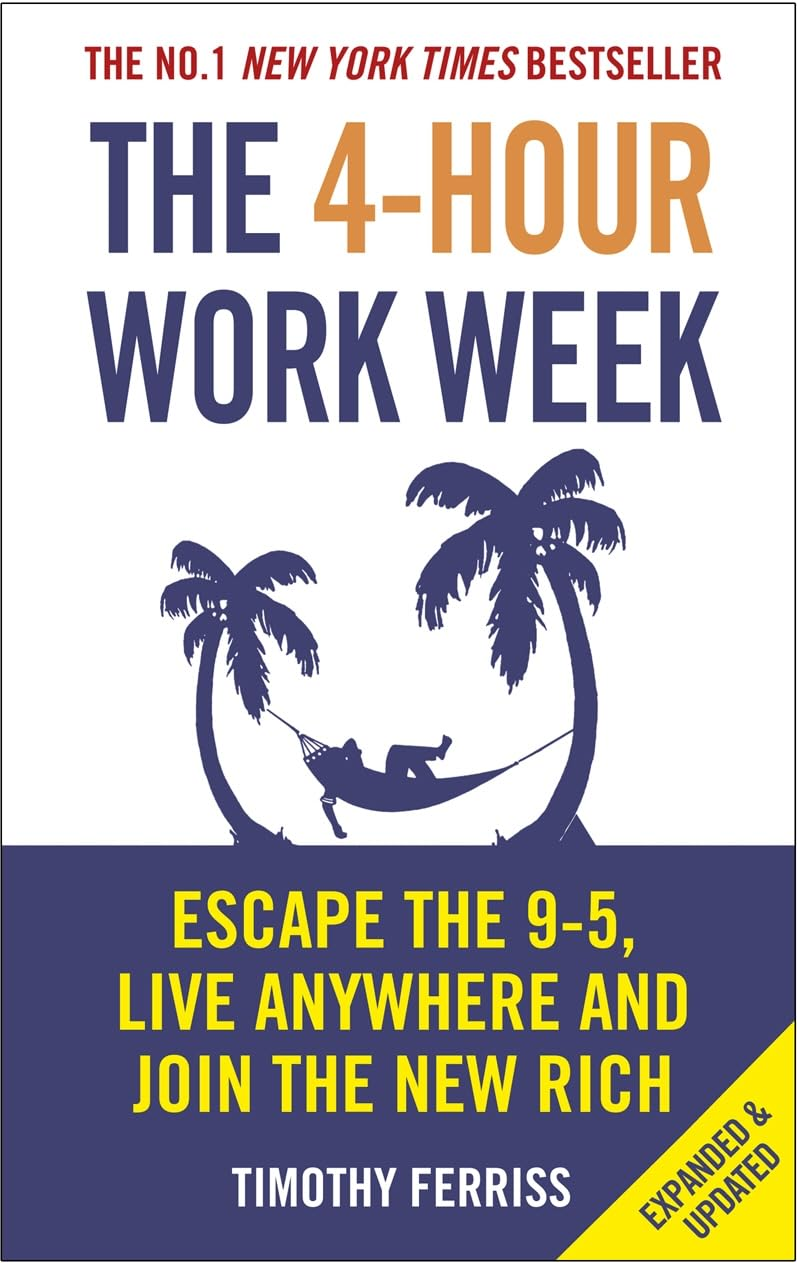
Tim Ferriss’s The 4-Hour Workweek is a blueprint for redesigning your life so that work supports freedom instead of consuming it. Rather than deferring happiness to retirement, Ferriss argues that we can live richly now by automating income, focusing only on the vital few tasks that create results, and reclaiming time for what matters. He calls this philosophy “Lifestyle Design.”
The book’s core idea is simple but radical: stop working for work’s sake. Replace long hours and busyness with intelligent systems, automation, and selective focus. Below are the key principles and how to apply them.
1. The New Rich: Redefining Success
Ferriss contrasts the “Deferrers”—people who postpone living until retirement—with the “New Rich” (NR), who value time and mobility over possessions. The New Rich measure wealth not by money alone but by freedom of location, time, and choice.
He urges readers to ask:
- What would you do if retirement were impossible?
- What excites you right now—not what you “should” want?
“Focus on being productive instead of busy.”
~ Tim Ferriss
The key is to stop chasing vague goals like “financial security” and start designing a life you’d actually want to live today.
2. The DEAL Framework
Ferriss structures the book around a four-part framework called D.E.A.L. — Definition, Elimination, Automation, and Liberation.
It serves as a step-by-step process to escape traditional work patterns.
Definition – Choose Freedom Over Convention
This stage challenges traditional assumptions about work and success. Most people wait for permission or retirement to live how they want. Ferriss says: start now.
He introduces Dreamlining, a written exercise to define what you want to be, do, and have in the next 6–12 months, and then calculate the real monthly cost. The point is to prove how surprisingly affordable most dreams are.
“People don’t want to be millionaires—they want to experience what they think only millions can buy.”
~ Tim Ferriss
By defining specific, vivid goals and their costs, you shift from impossible dreams to actionable plans.
Elimination – Do Less, Get More Done
Ferriss insists that time management is useless unless you first eliminate unnecessary work. He applies the 80/20 Rule (Pareto Principle)—80 percent of results come from 20 percent of efforts. Identify and amplify the few tasks that truly move the needle.
He also advocates the Law of Increased Productivity: limiting time increases focus. For example, reduce a day’s work to 2 hours and you’ll automatically prioritize only the critical tasks.
“Doing something unimportant well does not make it important.”
~ Tim Ferriss
He advises creating “not-to-do” lists, setting boundaries, batching tasks like email, and using selective ignorance—deliberately ignoring information that doesn’t serve your goals.
Automation – Let Systems Do the Work
Once you’ve eliminated the trivial, the next step is to automate income and processes. Ferriss popularized the idea of a muse—a small online business that runs with minimal time input.
He outlines practical methods:
- Outsource repetitive tasks to virtual assistants.
- Use e-commerce tools and digital payments to automate sales.
- Create autoresponders and standard operating procedures so decisions happen without you.
“The question you should be asking isn’t, ‘What do I want?’ or ‘What are my goals?’ but ‘What would excite me?’”
~ Tim Ferriss
Automation frees you from the illusion that you must personally manage every detail to maintain control.
Liberation – Escape the Office
The final step is mobility—designing your life so you can live and work anywhere. Ferriss describes negotiating remote work (“the remote deal”), testing productivity outside the office, and eventually creating a “mini-retirement” lifestyle: short sabbaticals every few months instead of a single retirement at the end.
“The goal is not to simply eliminate the bad, but to pursue and experience the best in the world.”
~ Tim Ferriss
He advises starting small—perhaps working from home a few days a week—then expanding gradually into location independence.
3. Escaping the 9-to-5 Trap
Ferriss dismantles the myth that security comes from a steady job. True security, he argues, comes from diversified skills and the ability to adapt. He encourages readers to break free from corporate dependence by creating alternative income streams.
He challenges the cultural belief that long hours equal virtue. Instead, he sees overwork as a symptom of poor focus and fear.
“Being busy is a form of laziness—lazy thinking and indiscriminate action.”
~ Tim Ferriss
He invites readers to design work that funds life experiences, not the other way around.
4. Mini-Retirements and Mobility
Instead of postponing travel or new experiences until old age, Ferriss proposes “mini-retirements”—periodic breaks to live elsewhere, learn new things, or simply rest.
He describes strategies to make these feasible:
- Reduce expenses by living abroad where the cost of living is lower.
- Rent out or sublet your home while away.
- Keep your business running remotely through automation and delegation.
“Someday is a disease that will take your dreams to the grave with you.”
~ Tim Ferriss
The underlying lesson is that life is not a dress rehearsal. You don’t need to wait for permission to begin living it.
5. Low-Information Diet
Ferriss introduces a concept called the Low-Information Diet: stop consuming endless news, notifications, and irrelevant data. Most information is noise, not action.
He recommends:
- Checking news only once per week.
- Setting specific times for email (e.g., twice daily).
- Using “auto-responses” to train people not to expect instant replies.
“Learn to be difficult when it counts. In every work environment, there is an invisible performance standard: the expectation that you will respond to everything. Resist it.”
~ Tim Ferriss
The result is sharper focus, calmer mind, and greater output in less time.
6. The Art of Refusal
One of Ferriss’s most underrated lessons is the skill of saying no. Most people drown in commitments because they can’t refuse requests. He teaches short, polite refusals and encourages protecting time as fiercely as money.
“What you don’t do determines what you can do.”
~ Tim Ferriss
Saying no to distractions is what allows space for what truly matters—creating, exploring, living.
7. The 80/20 Rule in Life and Business
Ferriss applies the Pareto Principle beyond work:
- 20 % of customers cause 80 % of problems—fire them.
- 20 % of products yield 80 % of revenue—focus on them.
- 20 % of activities yield 80 % of happiness—prioritize them.
He recommends regularly auditing both business and personal life to isolate these high-impact few. Doing less—but better—multiplies results.
“Doing less meaningless work so that you can focus on things of greater personal importance is not laziness. It is hard for most to accept.”
~ Tim Ferriss
This philosophy turns conventional work ethic upside-down, valuing effectiveness over sheer effort.
8. Fear-Setting: A New Way to Make Decisions
Instead of goal-setting, Ferriss practices fear-setting—a written exercise where you list:
- The worst that could happen.
- How you’d prevent it.
- How you’d recover if it did happen.
The process exposes that most fears are exaggerated, freeing you to act despite uncertainty.
“The fear of the unknown is the greatest fear of all—but when viewed differently, it can become your greatest adventure.”
~ Tim Ferriss
This technique transforms paralyzing anxiety into calculated risk-taking.
9. Remote Work and Liberation
Ferriss outlines strategies for transitioning from office dependence to remote work:
- Prove productivity improvements when working from home.
- Negotiate a temporary trial period.
- Use results-based metrics to measure performance.
Once success is demonstrated, location flexibility becomes hard for employers to refuse. Eventually, you can work entirely remotely or run your own ventures anywhere.
“For all their complaints about the world, the office isn’t the real problem—it’s the assumptions people never question.”
~ Tim Ferriss
10. Mini Experiments and Constant Adjustment
Ferriss treats life as a series of experiments, not permanent decisions. He suggests testing ideas with low risk and short timelines, then scaling what works. Whether it’s a product idea, travel plan, or personal challenge, progress comes from iteration.
“Conditions are never perfect. Someday is a myth. Start now—with fear, with uncertainty, with the first step.”
~ Tim Ferriss
Action, not planning, creates freedom.
11. Income Automation Blueprint (The Muse)
Ferriss provides a rough structure for building an automated business:
- Find a niche—something people already buy and you can improve or re-position.
- Test quickly—create a simple webpage, run ads, and validate demand before building anything complex.
- Automate fulfillment—use third-party suppliers, digital delivery, or dropshipping.
- Remove yourself—delegate all repeatable tasks.
The goal isn’t massive wealth but sustainable freedom—income without constant presence.
“The goal is free time and automatic income, not more money for more work.”
~ Tim Ferriss
12. Time and Mobility as the Real Wealth
Ferriss ends by reframing wealth itself: time and mobility are more valuable than any number in the bank. Most people chase money, believing it will buy freedom later. The New Rich reverse this: create freedom first, then let money serve it.
He encourages readers to measure success in moments of choice, not currency.
“Luxury is not owning a lot—it’s the freedom to do what you want when you want.”
~ Tim Ferriss
Freedom, not accumulation, is the true measure of a well-designed life.
Key Takeaways
- Redefine wealth as time and mobility, not possessions.
- Dreamline your ideal life and calculate what it truly costs.
- Apply the 80/20 Rule to eliminate 80 % of tasks that don’t matter.
- Use automation and outsourcing to remove yourself from the daily grind.
- Practice fear-setting to move past hesitation.
- Adopt mini-retirements to live fully now, not later.
- Focus relentlessly on effectiveness over efficiency.
- Remember: busyness is the opposite of productivity.
Final Reflection
The 4-Hour Workweek is less about working four hours a week than about freeing yourself from the illusion that life must revolve around labor. It’s a call to courage—to question inherited rules, to design a lifestyle that matches your values, and to use time as the rare, non-renewable currency it truly is.
“The question is not what we will do, but what we will do with the time we have.”
~ Tim Ferriss
Leave a Reply
You must be logged in to post a comment.