
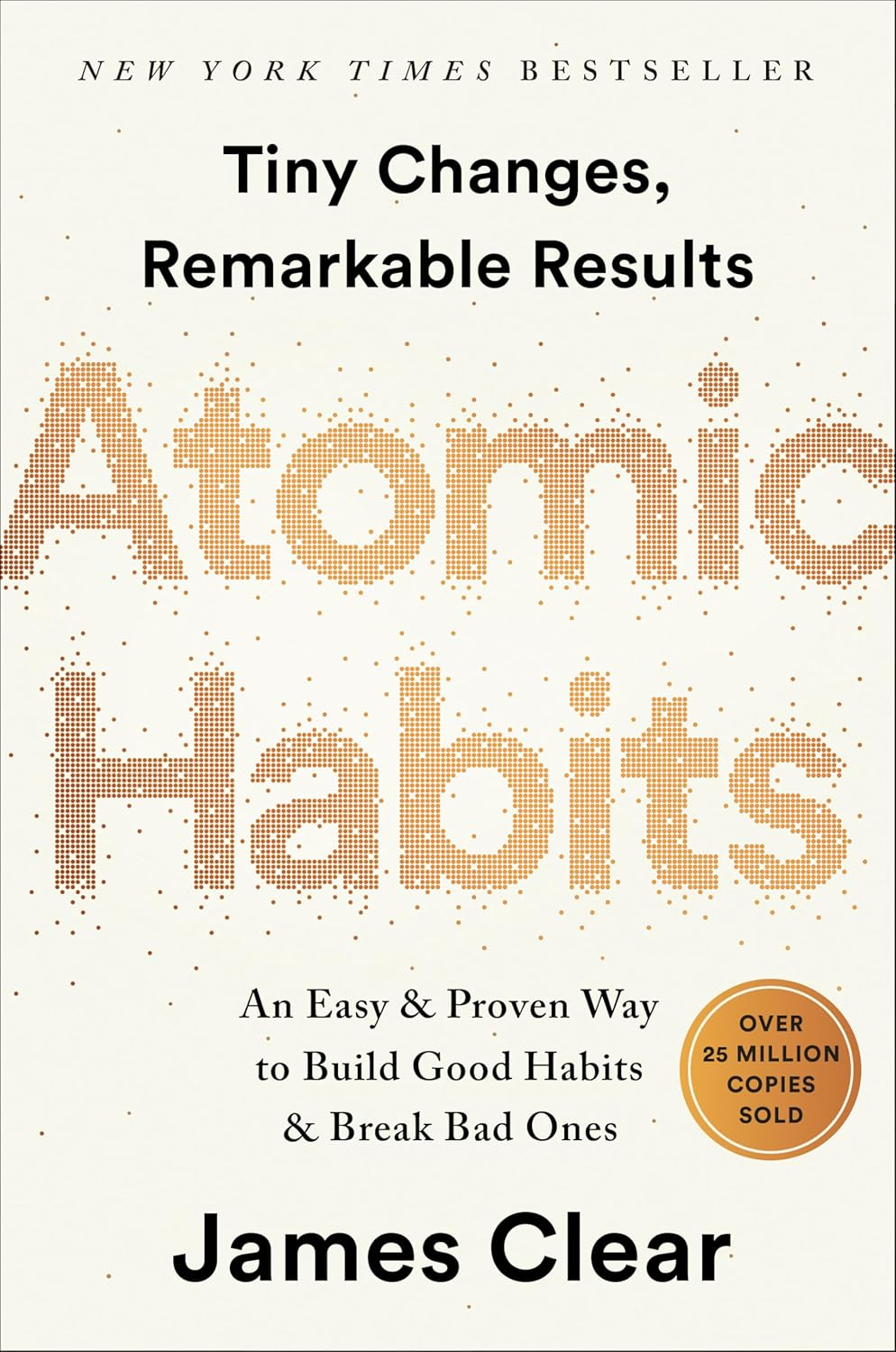
Overview
Atomic Habits is a guide to mastering the small, consistent actions that create extraordinary long-term results. James Clear argues that success isn’t about massive change, motivation, or willpower—it’s about systems, not goals. By improving just 1 percent each day, we can transform our habits, our identity, and our lives.
The book draws from psychology, neuroscience, and behavioral economics to explain why habits form and how to reshape them. Clear’s central insight is simple but profound: tiny changes compound like interest, and the person you become is the result of your daily habits, not your occasional ambitions.
“You do not rise to the level of your goals. You fall to the level of your systems.”
~ James Clear
1. The Power of Atomic Change
Clear defines an atomic habit as a small action that is both easy to do and incredibly powerful when compounded over time. Just as atoms are the building blocks of matter, small habits are the building blocks of transformation.
The problem with focusing on goals is that goals are about outcomes, while habits are about processes. Goals set direction; systems make progress inevitable.
“Habits are the compound interest of self-improvement.”
~ James Clear
Even small improvements—1 percent better each day—lead to exponential growth because of the law of compounding. The key is patience: meaningful change often hides beneath the surface for a long time before results appear.
2. The Four Laws of Behavior Change
At the heart of Atomic Habits is the Four-Step Model of Habit Formation: Cue → Craving → Response → Reward.
Every habit follows this loop, and Clear’s Four Laws of Behavior Change give a framework for creating good habits and breaking bad ones.
| To Build a Good Habit | Invert to Break a Bad Habit |
|---|---|
| 1. Make it obvious | 1. Make it invisible |
| 2. Make it attractive | 2. Make it unattractive |
| 3. Make it easy | 3. Make it difficult |
| 4. Make it satisfying | 4. Make it unsatisfying |
Each law targets a step in the habit loop, transforming unconscious patterns into deliberate design.
3. Law 1 – Make It Obvious
The first step to changing behavior is noticing it. Awareness turns automatic routines into conscious choices.
Clear recommends a Habits Scorecard: list your daily habits and mark whether each helps or harms you. Naming them exposes the invisible patterns running your life.
Then apply Implementation Intentions—a plan that turns vague goals into concrete actions:
“I will [behavior] at [time] in [location].”
Finally, use habit stacking: link a new habit to one you already do.
“After I brush my teeth, I will meditate for one minute.”
“You don’t need to overhaul your life overnight. You just need to be aware and intentional about what you’re already doing.”
~ James Clear
Visibility and clarity are the foundation of consistent change.
4. Law 2 – Make It Attractive
Habits become easier when they’re emotionally appealing. Clear draws on the Dopamine Loop: anticipation of reward motivates repetition more than the reward itself.
To harness this, pair a habit you need to do with one you want to do—what he calls temptation bundling.
Example: “I will only watch Netflix while exercising on the bike.”
Also, surround yourself with people whose behaviors reflect the habits you want to adopt. Social influence is powerful; we tend to mirror the expectations of those around us.
“One of the most effective things you can do to build better habits is to join a culture where your desired behavior is the normal behavior.”
~ James Clear
Attraction comes from association—link new habits to positive emotions and supportive communities.
5. Law 3 – Make It Easy
The key to habit success isn’t motivation—it’s friction. Make good habits easy and bad ones hard.
Clear’s Two-Minute Rule helps overcome procrastination:
“When you start a new habit, it should take less than two minutes to do.”
Reading for two minutes becomes reading a chapter. Lacing your shoes becomes running. The point is to master showing up—once a habit is started, momentum takes over.
He also recommends environment design:
- Place cues for good habits where you’ll see them (fruit on the counter, books on your pillow).
- Hide cues for bad ones (remove junk food, turn off notifications).
“Environment is the invisible hand that shapes human behavior.”
~ James Clear
We don’t need to rely on willpower when the world around us does the work for us.
6. Law 4 – Make It Satisfying
We repeat behaviors that feel rewarding. To lock in habits, make progress visible and satisfying.
Clear advises using habit tracking—mark an X on a calendar each time you complete a habit. Seeing the streak itself becomes motivating.
He introduces the “never miss twice” rule: failure is inevitable, but consistency survives if you resume immediately.
“Missing once is an accident. Missing twice is the start of a new habit.”
~ James Clear
Immediate reinforcement beats distant rewards. Celebrate completion, no matter how small—it tells your brain, this matters.
7. Identity: The Core of All Habits
The most transformative idea in Atomic Habits is that identity shapes behavior more powerfully than outcomes do. Lasting change isn’t about what you want to achieve, but about who you believe you are.
“The ultimate form of intrinsic motivation is when a habit becomes part of your identity.”
~ James Clear
Instead of saying, “I want to run a marathon,” say, “I’m a runner.”
Instead of “I want to quit smoking,” say, “I’m not a smoker.”
Every small habit is a vote for the type of person you want to become. Change your identity through action, and the results follow naturally.
8. The Plateau of Latent Potential
Clear describes a common frustration: the feeling that effort isn’t paying off. He calls this the Plateau of Latent Potential—the invisible phase where results haven’t yet appeared, though progress is building beneath the surface.
“Complaining about not achieving success despite working hard is like complaining about an ice cube not melting when you’ve just started to heat it.”
~ James Clear
Habits compound silently until one day they cross a threshold and visible transformation occurs. The key is persistence—trusting the process during the quiet phase of growth.
9. Breaking Bad Habits
To reverse a habit, invert each of the Four Laws:
- Make it invisible – Remove cues that trigger the habit.
- Make it unattractive – Reframe how you think about it (see the truth, not the pleasure).
- Make it difficult – Increase friction; add steps or delay access.
- Make it unsatisfying – Add accountability or immediate consequence.
“Self-control is a short-term strategy. Environment design is a long-term one.”
~ James Clear
The goal isn’t willpower—it’s restructuring the context so the wrong choice is the hardest one to make.
10. The Role of Systems
Clear contrasts goals and systems:
- Goals are about results you want.
- Systems are about the processes that lead to those results.
Focusing only on goals leads to a “yo-yo” pattern—temporary success, then relapse. Systems create sustainability.
“You do not rise to the level of your goals; you fall to the level of your systems.”
~ James Clear
Examples of systems thinking:
- Instead of aiming to “get fit,” focus on creating a system of daily movement and meal planning.
- Instead of aiming to “write a book,” focus on a system of writing 500 words every morning.
11. The Goldilocks Rule
To stay motivated, tasks should be just right—not too easy, not too hard. We thrive on challenges that stretch us slightly beyond comfort.
“Humans experience peak motivation when working on tasks that are right on the edge of their current abilities.”
~ James Clear
He calls this the Goldilocks Zone—where growth feels meaningful, not overwhelming. The balance of difficulty and skill keeps you in flow.
12. The Downside of Success
Even good habits can turn rigid if they’re never re-examined. Clear warns against identity stagnation—becoming so attached to who you think you are that you stop evolving.
“The tighter you cling to your current identity, the harder it becomes to grow beyond it.”
~ James Clear
The antidote is continual self-reflection: review habits regularly, adjust systems, and stay flexible. True mastery is constant learning.
13. Practical Applications
Clear offers tools to implement the theory in everyday life:
- Habit stacking: Attach new actions to existing ones (“After I pour my coffee, I’ll write my to-do list”).
- Environment redesign: Shape surroundings for success (put your gym clothes by the bed).
- Accountability partners: Public commitment increases follow-through.
- Habit tracking: Use visual cues to maintain momentum.
- Two-minute rule: Shrink new habits to a minimal starting point.
- Never miss twice: Forgive failure, then immediately return to rhythm.
Each tactic builds stability through simplicity.
14. The Aggregation of Marginal Gains
Borrowing from elite sports psychology, Clear highlights the British Cycling story: small improvements in many areas led to huge performance leaps. Likewise, 1 percent improvements across dozens of daily choices create massive change over years.
“If you can get 1 percent better each day for one year, you’ll end up thirty-seven times better by the time you’re done.”
~ James Clear
Greatness is rarely about radical effort—it’s about tiny, repeated consistency.
15. The Long Game: Habits and Meaning
In the end, Clear reframes habits not as a way to control life, but as a way to align your actions with your values. The goal is not perfection, but alignment between who you are, what you do, and what matters most.
“The secret to getting results that last is to never stop making improvements.”
~ James Clear
When good habits become part of identity, they require less discipline and more awareness. The compound effect of those choices becomes a life built deliberately, not by default.
Key Takeaways
- Small habits make a big difference. Tiny actions, repeated, transform identity.
- Focus on systems, not goals. Sustainable change comes from process design.
- Awareness precedes change. Name your habits to control them.
- Shape the environment. Make good habits easy, bad ones hard.
- Identity drives behavior. Become the kind of person who naturally does what you want to do.
- Track progress visually. Small wins keep momentum alive.
- Embrace patience. Results compound slowly, then suddenly.
- Never miss twice. Consistency beats intensity.
- Stay adaptable. Review, refine, and grow beyond your past identity.
Final Reflection
Atomic Habits isn’t about doing more—it’s about doing better, smaller, and smarter. Clear’s message is that lasting success comes from invisible actions performed daily, with intention. It’s not about motivation but design; not about massive leaps but steady steps.
“Every action you take is a vote for the type of person you wish to become.”
~ James Clear
If you want to change your life, don’t aim for transformation.
Start with one small, atomic habit—and let time do the rest.
bandonment of your goals. Even small efforts, repeated over time, can lead to substantial progress.
Success is the product of daily habits—not once-in-a-lifetime transformations.
~ James Clear
Building Long-Term Systems for Success
The book concludes by emphasizing the importance of creating systems that support your habits over the long term. Instead of relying on willpower, design your environment and daily routines in a way that naturally reinforces your goals. Clear stresses that sustainable change is a lifelong process, not a one-time event, and that focusing on small, consistent improvements is the key to lasting success.
You should be far more concerned with your current trajectory than with your current results.
~ James Clear
Leave a Reply
You must be logged in to post a comment.