
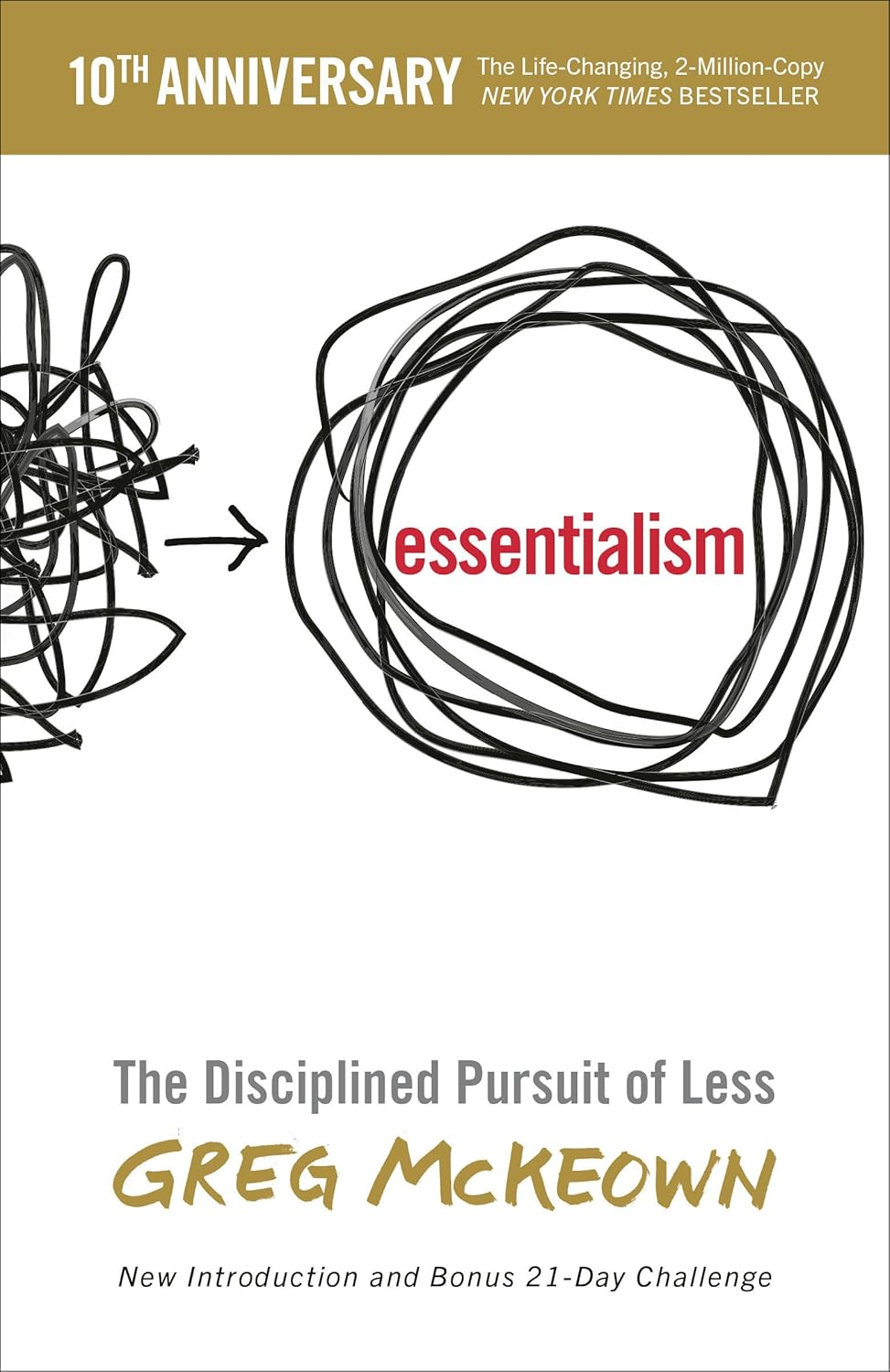
Essentialism: The Disciplined Pursuit of Less, by Greg McKeown – 2000-word book summary
Overview
Greg McKeown’s Essentialism is a call to focus on what truly matters. It’s not about doing more things—it’s about doing the right things. In a world obsessed with productivity and busyness, McKeown argues that success comes not from adding but from subtracting—eliminating the trivial so that we can give our full attention to what’s essential.
The essentialist philosophy rests on one profound truth: “If you don’t prioritize your life, someone else will.”
This book is both a mindset and a disciplined practice of saying no to almost everything so you can say a powerful yes to the few things that count.
1. The Essence of Essentialism
At its core, Essentialism is the relentless pursuit of less but better. It’s not minimalism or laziness—it’s about clarity, purpose, and deliberate choice.
McKeown contrasts the Non-Essentialist (who tries to do it all) with the Essentialist (who chooses carefully). The Non-Essentialist spreads themselves thin; the Essentialist concentrates on what really moves the needle.
“If you don’t prioritize your life, someone else will.”
~ Greg McKeown
Essentialism begins by asking three questions:
- What is truly important right now?
- What can only I do?
- What would happen if I didn’t do this at all?
By constantly filtering your commitments through these questions, you gradually reclaim control over your time, energy, and direction.
2. The Core Mindset: Choice, Trade-Offs, and Clarity
McKeown argues that clarity is power. Essentialists recognize three fundamental truths:
- I choose to do things—nothing is truly forced upon me.
- Almost everything is noise—only a few things have lasting value.
- Every choice is a trade-off—saying yes to one thing means saying no to others.
“Remember that if you don’t decide what your priorities are, someone else will.”
~ Greg McKeown
By owning your choices, you regain agency. Essentialists see trade-offs not as sacrifices but as strategic decisions. The question changes from “How can I do it all?” to “What can I go big on?”
3. Explore: Discern the Vital Few from the Trivial Many
To live as an Essentialist, you must explore before you commit. Instead of rushing to say yes, pause to evaluate opportunities.
McKeown introduces the 90 Percent Rule:
When deciding whether to pursue something, score it from 0 to 100. If it’s not a 90 or above, treat it as a 0.
“If it’s not a definite yes, it’s a definite no.”
~ Greg McKeown
He encourages spending more time exploring what truly inspires you—asking, reading, listening, reflecting. You must create space for discernment because focus requires clarity, and clarity requires pause.
4. Eliminate: Cutting Out the Non-Essential
Once you know what matters, you must eliminate what doesn’t—ruthlessly. Every “yes” carries an invisible cost in energy, focus, and freedom.
McKeown suggests several strategies:
- Learn to say no gracefully. “I’m flattered, but I can’t commit right now.”
- Stop trying to please everyone. You can’t, and you shouldn’t.
- Apply zero-based thinking. If this weren’t already part of my life, would I add it now?
“If you don’t set boundaries, others will set them for you.”
~ Greg McKeown
The power of Essentialism lies not in getting more done, but in getting the right things done. Removing the trivial creates space for excellence.
5. Execute: Make Doing the Essential as Effortless as Possible
After deciding what’s essential and cutting out the rest, the next step is to make execution automatic and smooth.
McKeown calls this “creating a system for effortless action.” You remove friction, simplify routines, and focus on progress, not perfection.
Methods include:
- Buffer for the unexpected. Always allow margin for surprises.
- Design routines. Structure eliminates decision fatigue.
- Start small but start now. Tiny consistent actions compound over time.
“Focus on what you can control and make it as easy as possible to do what matters most.”
~ Greg McKeown
When the path to the essential is clear and simple, resistance fades—and consistency follows.
6. Boundaries: Protecting What Matters Most
Essentialists build fences around their priorities. McKeown likens boundaries to walls protecting your focus. They’re not restrictive; they’re liberating.
By saying “no” to the unimportant, you create freedom to say “yes” to meaning. This includes scheduling rest, guarding family time, and disconnecting from constant communication.
“Boundaries are a way of protecting your time and energy so you can give your best self where it counts.”
~ Greg McKeown
True discipline is not rigidity—it’s conscious design. The Essentialist is not always busy, but always aligned.
7. The Power of Pause and Play
McKeown highlights that rest and play are not luxuries—they are essential to clarity and creativity. When you constantly rush, your brain operates in reactive mode; when you rest, it connects ideas and renews insight.
“Play, by its very nature, is essential to creativity.”
~ Greg McKeown
He points to research showing that creativity and breakthrough ideas often come during downtime, not while grinding. Scheduling play, rest, and reflection allows the mind to breathe—and that’s when clarity emerges.
8. Sleep: The Ultimate Performance Enhancer
Essentialists guard their sleep as fiercely as their time. McKeown cites neuroscience showing that sleep improves decision-making, creativity, and emotional balance.
“Protect the asset—yourself.”
~ Greg McKeown
By neglecting sleep, you damage the very instrument of your effectiveness. Rest isn’t indulgence—it’s maintenance for sustained excellence.
9. Saying No Without Guilt
Many people stay overwhelmed because they can’t refuse requests. McKeown devotes an entire section to the art of saying no gracefully.
He recommends short, polite refusals that affirm your respect for others while protecting your focus. For example:
- “I would love to, but I don’t have the bandwidth right now.”
- “Let me check my priorities and get back to you.”
- “I’m honored, but I must decline.”
“Remember that denying a request is not denying the person.”
~ Greg McKeown
Each “no” to the trivial strengthens your “yes” to the essential.
10. Trade-Offs: You Can Do Anything, but Not Everything
The Essentialist accepts that trade-offs are part of life. Instead of pretending they don’t exist, they choose them consciously.
For example: you might trade late nights for better health, or smaller profits for creative control. The key is to make those trade-offs deliberate, not accidental.
“You can’t have it all. But you can have what matters most.”
~ Greg McKeown
When you embrace limits, you gain freedom to excel in fewer areas that actually count.
11. Focus: The Power of One Thing at a Time
McKeown argues that multitasking scatters energy and destroys depth. Essentialists focus deeply on one meaningful task at a time.
He recommends blocking uninterrupted time for important work, turning off notifications, and committing fully to the present task.
“Clarity of purpose allows you to focus your time and energy on what’s truly important.”
~ Greg McKeown
Depth—not speed—is the hallmark of excellence.
12. Leadership and Essentialism
McKeown applies Essentialism to leadership as well. Great leaders don’t do more—they do less, better. They focus their teams on a few critical priorities and eliminate the noise.
He gives examples of companies like Apple under Steve Jobs, which thrived by reducing its product line to focus on a few exceptional products.
“When you focus on everything, you focus on nothing.”
~ Greg McKeown
Leadership through Essentialism means clarity, focus, and courage to eliminate distractions.
13. The Joy of Missing Out (JOMO)
Essentialists don’t fear missing out (FOMO)—they embrace the joy of missing out (JOMO). By deliberately opting out of trivial pursuits, they create space for peace, creativity, and meaningful connection.
“There are far more things we could do than we can ever do. Once we accept that, we are free.”
~ Greg McKeown
The Essentialist’s life is lighter, calmer, and richer—not because they have less, but because they value what remains.
14. Designing an Essential Life
McKeown concludes that Essentialism isn’t a one-time choice—it’s a way of living. Each day offers chances to re-evaluate priorities, eliminate distractions, and focus on purpose.
He advises creating a personal Essential Intent—a concise statement that captures what matters most to you. This becomes your compass for decisions.
“Our highest priority is to protect our ability to prioritize.”
~ Greg McKeown
Living essentially means designing each day intentionally so that your actions align with your deepest values.
Key Principles of Essentialism
| Principle | Description |
|---|---|
| Choose | You have control. Say yes or no deliberately. |
| Discern | Separate the vital few from the trivial many. |
| Eliminate | Remove what doesn’t serve your purpose. |
| Execute | Make what matters effortless through structure. |
| Protect | Guard your time, energy, and focus like treasure. |
Key Takeaways
- Clarity creates focus. Know what matters most and commit to it.
- Trade-offs are unavoidable. Choose them consciously.
- If it isn’t a “hell yes,” it’s a no.
- Boundaries aren’t selfish—they’re essential.
- Sleep, play, and rest fuel excellence.
- Less but better is not reduction—it’s refinement.
- Focus deeply on one thing at a time.
- Protect your time from the trivial.
- The disciplined pursuit of less leads to more meaning.
Final Reflection
Essentialism isn’t about getting more done—it’s about getting the right things done. It’s a guide to living with clarity, control, and purpose in a chaotic world that rewards busyness over brilliance.
McKeown’s message is deeply countercultural but liberating: stop measuring your worth by how much you do, and start measuring it by how deliberately you live.
“If you could do only one thing with your life, what would it be?”
~ Greg McKeown
That’s the question at the heart of Essentialism—and the answer is the beginning of a life that finally feels your own.
Leave a Reply
You must be logged in to post a comment.