
Overview
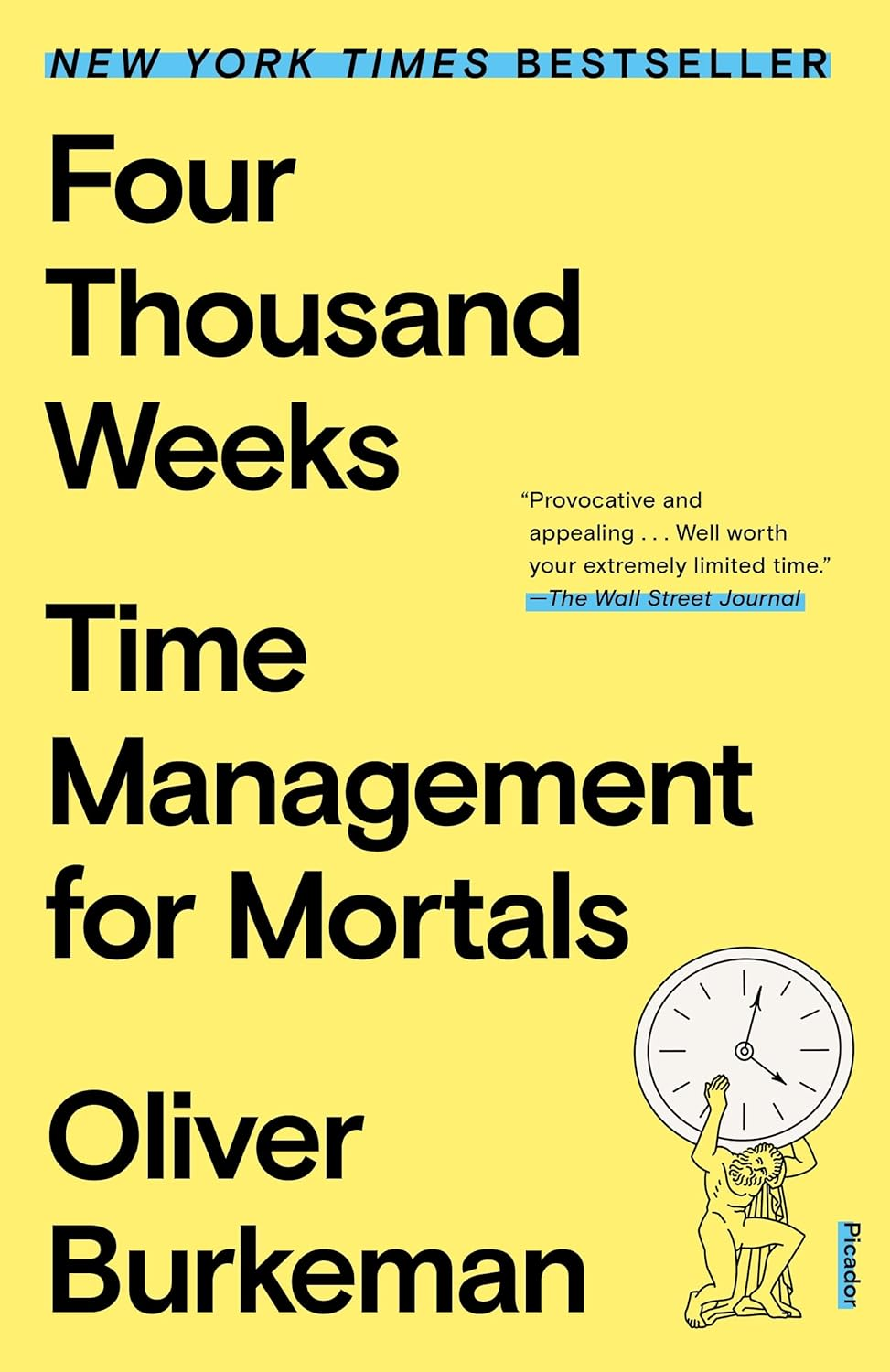
Oliver Burkeman’s Four Thousand Weeks isn’t your typical time-management book. Its title refers to the roughly four thousand weeks that make up an average human lifespan — a stark reminder of how brief life truly is. Instead of offering productivity hacks, Burkeman dismantles the modern obsession with efficiency and control, arguing that our time on Earth is limited, uncontrollable, and best lived deliberately, not perfectly.
At its heart, the book is about accepting finitude — embracing our limits rather than fighting them. Burkeman shows how freedom and peace come not from doing everything, but from realizing we never could.
“The average human lifespan is absurdly, terrifyingly, insultingly short.”
~ Oliver Burkeman
1. Facing Our Finitude
Most people live as if time is something they can conquer — as though, with enough discipline, they’ll finally reach a point where everything is done. Burkeman calls this the productivity trap: the belief that someday you’ll “get on top of things.” That day never comes.
“The day will never arrive when you finally have everything under control — when the flood of obligations, emails, and to-dos has receded.”
~ Oliver Burkeman
He argues that time management, as it’s typically practiced, is often a way of avoiding the truth of mortality. We try to make ourselves invincible through control, forgetting that time itself can never be mastered — only lived.
Instead of resisting our limitations, Burkeman invites us to confront them head-on. Doing so, he says, is the beginning of wisdom.
2. The Myth of Control
We treat time as a possession — something to “spend” or “save.” But time isn’t an object; it’s the medium of life itself. Trying to control it only increases anxiety.
“You can’t live your life in the future any more than you can breathe next week’s air.”
~ Oliver Burkeman
Every effort to control time — through multitasking, over-scheduling, or endless planning — only creates tension. The more you try to optimize life, the less you experience it.
The real power lies in surrendering control and engaging fully with the messy, unpredictable present.
3. The Paradox of Limitation
Burkeman insists that limits aren’t the enemy — they give life meaning. Having only four thousand weeks forces us to choose. Without boundaries, our actions would be meaningless.
“It’s by consciously confronting the reality of our limits that we become the creators of meaningful lives.”
~ Oliver Burkeman
Instead of resenting limitation, embrace it as structure. Constraints — time, mortality, imperfection — are what make life precious and creativity possible.
4. The Efficiency Trap
Modern society worships efficiency, but Burkeman calls it a trap. The more efficiently you do something, the more demands fill the space you create. Answer emails faster, and you’ll get more emails. Streamline your schedule, and more tasks appear.
“Productivity is a trap. Becoming more efficient just makes you more rushed.”
~ Oliver Burkeman
He urges readers to stop optimizing and start focusing. Instead of trying to do everything faster, choose fewer things worth doing at all.
5. The Joy of Missing Out
We live in an era of infinite options — infinite entertainment, information, experiences. Every “yes” is a thousand “no’s.” Burkeman argues that peace comes from decisively missing out.
“The freedom of limitless choice isn’t freedom at all; it’s paralysis.”
~ Oliver Burkeman
You’ll never experience every possibility, so stop trying. Happiness lies in commitment — in closing doors, not keeping them open. Saying yes to what truly matters means embracing the grief of letting go of what doesn’t.
This is the opposite of FOMO. It’s JOMO — the joy of missing out.
6. Choosing What to Fail At
Since we can’t do everything, we must choose what to fail at intentionally. Burkeman calls this “strategic underachievement.”
“You have to choose your regrets.”
~ Oliver Burkeman
By deciding what not to prioritize, you gain clarity and peace. Maybe you’ll be a great parent but an average gardener, or a skilled writer but a mediocre cleaner. The point isn’t perfection — it’s conscious imperfection.
Every “failure” is the cost of doing something that truly matters.
7. The Problem with “Getting Things Done”
Burkeman challenges the belief that if we just find the right system, we’ll reach a state of total order. This endless self-optimization is another form of avoidance — an attempt to delay facing mortality.
“We treat our lives as though they’re problems to be solved rather than experiences to be lived.”
~ Oliver Burkeman
He points out that no system can eliminate uncertainty. Accepting imperfection and unpredictability is the only way to find calm. Instead of trying to “master time,” master your attitude toward it.
8. The Cosmic Insignificance Therapy
One of the book’s most liberating ideas is “cosmic insignificance therapy.”
We obsess over doing something “big” with our lives, but in cosmic terms, we’re dust — and that’s freeing.
“The average human lifespan is 4,000 weeks long. That’s all you get if you’re lucky. But you’ll never be able to use it well if you spend your days trying to prove your importance.”
~ Oliver Burkeman
When you realize your life is just one small part of an infinite universe, the pressure to do something world-shaking fades. You’re free to focus on what actually matters to you — loving, learning, creating, and living well today.
9. Patience and Presence
Burkeman draws on philosophy and Buddhism to argue that meaning arises from being fully in time, not managing it.
Modern impatience — the urge for immediate results — disconnects us from reality. Slowness, patience, and attention restore connection.
“Patience isn’t just waiting longer. It’s learning to be where you are, when you are.”
~ Oliver Burkeman
He encourages simple practices: walking without checking your phone, doing one task at a time, embracing boredom. These slow moments open the door to depth and clarity.
10. The Power of Commitment
Freedom is often misunderstood as keeping all options open. But true freedom, Burkeman argues, comes from commitment.
“To be fully alive is to be committed to something or someone.”
~ Oliver Burkeman
Committing to one person, one craft, or one path gives your life shape and meaning. Refusing to commit keeps you in a perpetual state of distraction and anxiety — always searching, never arriving.
He calls this the finite life paradox: only by accepting limitation can you experience real freedom.
11. Time and Mortality
Burkeman emphasizes that death gives life its urgency and beauty. Denying mortality leads to emptiness; embracing it brings appreciation.
“Mortality makes us mortal — and it’s precisely what makes us matter.”
~ Oliver Burkeman
He argues that realizing we’ll die helps us see how precious each moment is. The problem isn’t that life is too short — it’s that we waste it trying to make it longer, safer, or more efficient instead of fully living now.
12. Rediscovering Wonder
Burkeman suggests that time slows down when we truly notice things — when we see the world with childlike attention. Wonder reconnects us to life beyond the clock.
“The world is astonishing when you stop trying to control it.”
~ Oliver Burkeman
The more we immerse ourselves in the richness of the present, the less time feels like something slipping away. Wonder collapses time into experience.
13. The Antidote to Anxiety
Burkeman connects anxiety to resistance — the futile effort to escape uncertainty. Life is unpredictable by nature; peace comes from surrendering to it.
He advises developing a “radical acceptance” of reality: stop wishing time were different.
“We suffer because we want things to be other than they are.”
~ Oliver Burkeman
When you stop fighting time, you begin to feel time — as it is — unfolding through you. That realization brings calm.
14. Tools for Living Within Limits
Burkeman offers practical ways to live wisely with our 4,000 weeks:
- Limit tasks to three or four meaningful ones per day.
- Create open, unscheduled time. Leave space for life to happen.
- Set boundaries on technology. The digital world feeds the illusion of infinite possibility.
- Embrace “fixed volume” productivity. Only take on what fits into your finite time.
- End projects. Closing loops gives emotional space.
Each of these choices reinforces the same idea: less control, more living.
15. Letting Things Be Unfinished
One of the hardest lessons is that everything will remain incomplete. Projects, relationships, ambitions — none will be perfect or final.
“The world will go on without your to-do list being done.”
~ Oliver Burkeman
Once you stop demanding completion, you can act freely. Paradoxically, this acceptance often makes you more productive because you’re no longer paralyzed by perfectionism.
16. The Beauty of Limits
Burkeman concludes that finitude is not a tragedy—it’s what gives life intensity and meaning. Knowing we only have a few thousand weeks makes each day more vivid.
“You get to be here. You get to have this brief, luminous experience.”
~ Oliver Burkeman
The awareness of death isn’t depressing; it’s enlivening. It invites gratitude, clarity, and courage.
Key Takeaways
- You have about 4,000 weeks to live — accept this as a gift, not a problem.
- You’ll never get everything done—and you don’t need to.
- Stop chasing efficiency; focus on meaningful work instead.
- Limits create freedom—choose what truly matters and let the rest go.
- Patience is the ability to be present, not to wait longer.
- Commitment gives life structure and depth.
- Mortality makes life precious — awareness of death is a source of joy.
- Wonder and attention expand your sense of time.
- True peace comes from surrendering control, not gaining it.
Final Reflection
Four Thousand Weeks is both sobering and liberating. It reminds us that time isn’t something we manage — it’s the raw material of our existence. The goal isn’t to fit more into life, but to fit life into time: to be fully present, to choose wisely, and to let go of everything that doesn’t matter.
“The real measure of any life is not its length, but what you pay attention to while you’re living it.”
~ Oliver Burkeman
The book’s message is beautifully simple: you don’t need more time — you need to realize that now is all the time you’ll ever have.
Old summary:
Overview
Summary: “Four Thousand Weeks” by Oliver Burkeman challenges conventional time management philosophies by confronting the finite nature of human life—approximately 4,000 weeks if one lives to 80. Burkeman argues that the relentless pursuit of efficiency and productivity often leads to stress and unfulfilled aspirations. Instead, he advocates for embracing our limitations, focusing on what truly matters, and finding meaning within the constraints of our brief existence.
Key Learning: Accepting the finite nature of time allows us to prioritize meaningful activities and relationships, leading to a more fulfilling life.
“The average human lifespan is absurdly, terrifyingly, insultingly short.”
~ Oliver Burkeman
The Limits of Time
Summary: Burkeman introduces the concept of “cosmic insignificance therapy,” suggesting that recognizing our smallness in the universe can alleviate the pressure of trying to do everything. He critiques the “efficiency trap,” the false belief that with enough optimization, we can fit everything into our lives, leading to increased busyness without fulfillment.
Key Learning: Embrace your limitations and focus on what truly matters, rather than attempting to optimize every moment.
“The day will never arrive when you finally have everything under control.”
~ Oliver Burkeman
The Productivity Paradox
Summary: The author exposes the futility of trying to “get on top of everything,” introducing the idea of “digital overwhelm,” where technology exacerbates our time anxiety. He discusses the “paradox of limitation,” how constraints can enhance creativity and productivity.
Key Learning: Acknowledge that you cannot do everything; instead, choose a few meaningful tasks and commit to them fully.
“Productivity is a trap. Becoming more efficient just makes you more rushed.”
~ Oliver Burkeman
Embracing Finitude
Summary: Burkeman advocates for “strategic underachievement,” deliberately choosing what to fail at to focus on what matters. He introduces the concept of “fixed volume,” the idea that adding a new commitment always means subtracting from something else.
Key Learning: Deliberately decide which tasks or commitments to let go, allowing you to focus on what truly matters.
“The more you try to manage your time with the goal of achieving a feeling of total control and freedom from limitation, the more stressful, empty, and frustrating life gets.”
~ Oliver Burkeman
The Art of Patience
Summary: The book discusses the value of patience in a world obsessed with instant gratification, exploring “existential overwhelm,” the paralysis from confronting life’s biggest questions. Burkeman emphasizes living more in the present rather than constantly planning for the future.
Key Learning: Practice patience and presence, focusing on the current moment to find fulfillment.
Redefining Success
Summary: Burkeman challenges readers to reconsider their definition of a “successful” life, introducing the idea of “cosmic significance,” finding meaning in small, everyday actions. He argues for embracing uncertainty as a path to a more authentic and fulfilling life.
Key Learning: Redefine success based on personal values and the significance of everyday actions, rather than societal expectations.
“We’ve been granted the mental capacities to make almost infinitely ambitious plans, yet practically no time at all to put them into action.”
~ Oliver Burkeman
Conclusion
Summary: “Four Thousand Weeks” encourages readers to embrace the finite nature of time, challenging the obsession with productivity and efficiency. By accepting our limitations and focusing on meaningful activities, Burkeman suggests we can lead more fulfilling and intentional lives.
Key Learning: Accepting the brevity of life allows you to focus on what truly matters, leading to a more intentional and meaningful existence.
“The world is bursting with wonder, and yet it’s the rare productivity guru who seems to have considered the possibility that the ultimate point of all our frenetic doing might be to experience more of that wonder.”
~ Oliver Burkeman
Leave a Reply
You must be logged in to post a comment.