
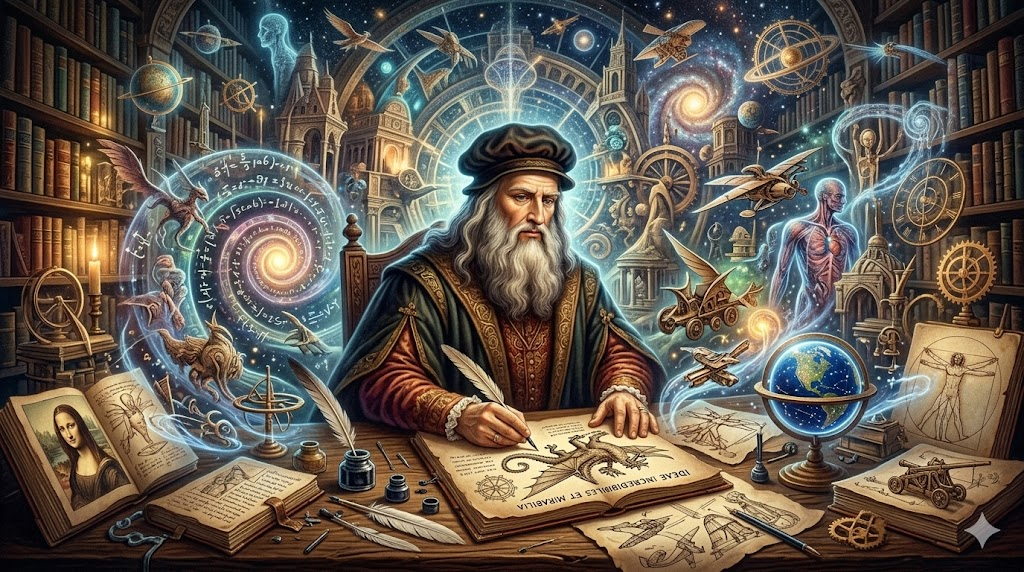
He wasn’t just the painter of the Mona Lisa. He was one of history’s most disciplined thinkers — and greatest geniuses. His notebooks reveal habits that still separate ordinary performers from extraordinary ones. So what can we learn from da Vinci?
He left behind 13,000+ pages of notes — curiosity was his real genius. Leonardo didn’t wait for inspiration. He engineered it by writing everything down — questions, sketches, observations.
Modern application: Leaders like Elon Musk use first-principles thinking to break complex problems into fundamentals. Train your curiosity. Document your thinking.
He dissected 30+ human bodies — depth beats surface knowledge
While others painted appearances, Leonardo studied anatomy to understand structure.
Modern application: In an age of AI and automation, shallow skills are replaceable. Deep expertise creates leverage and authority.
He designed flying machines 400 years before airplanes existed
His imagination outran the limits of his century.
Modern application: Entrepreneurs like Jeff Bezos invested in space travel long before it was practical. Think beyond current constraints — technology eventually catches up to bold ideas.
The Mona Lisa took 16 years — mastery refuses to rush
Leonardo refined endlessly, layering detail over time.
Modern application: Companies like Apple Inc. obsess over iteration before release. Excellence compounds through refinement, not speed alone.
He wrote in mirror script — protect fragile ideas early
Original thinking is vulnerable in its early stages. Leonardo guarded his work while it developed.
Modern application: Many startups operate in stealth mode before launching publicly. Not every idea needs immediate exposure.
He blended art and science — specialization wasn’t enough
Engineering and beauty were the same pursuit to him.
Modern application: Innovators like Steve Jobs fused technology with design. The future belongs to integrators who connect disciplines.
He questioned authority — observation over tradition
Leonardo trusted evidence more than inherited belief.
Modern application: Breakthroughs in biotechnology, renewable energy, and AI happen because someone tests assumptions instead of accepting them.
He left many projects unfinished — exploration fueled innovation
Movement between disciplines sparked cross-pollination of ideas.
Modern application: The most creative founders and thinkers often explore widely before narrowing focus. Experimentation creates unexpected breakthroughs.
The real lesson: curiosity compounds over decades
Leonardo’s brilliance wasn’t a single moment. It was accumulation — page after page, question after question.
In a distracted world, sustained curiosity is a competitive advantage. Read widely. Think deeply. Write everything down.
Leave a Reply
You must be logged in to post a comment.