
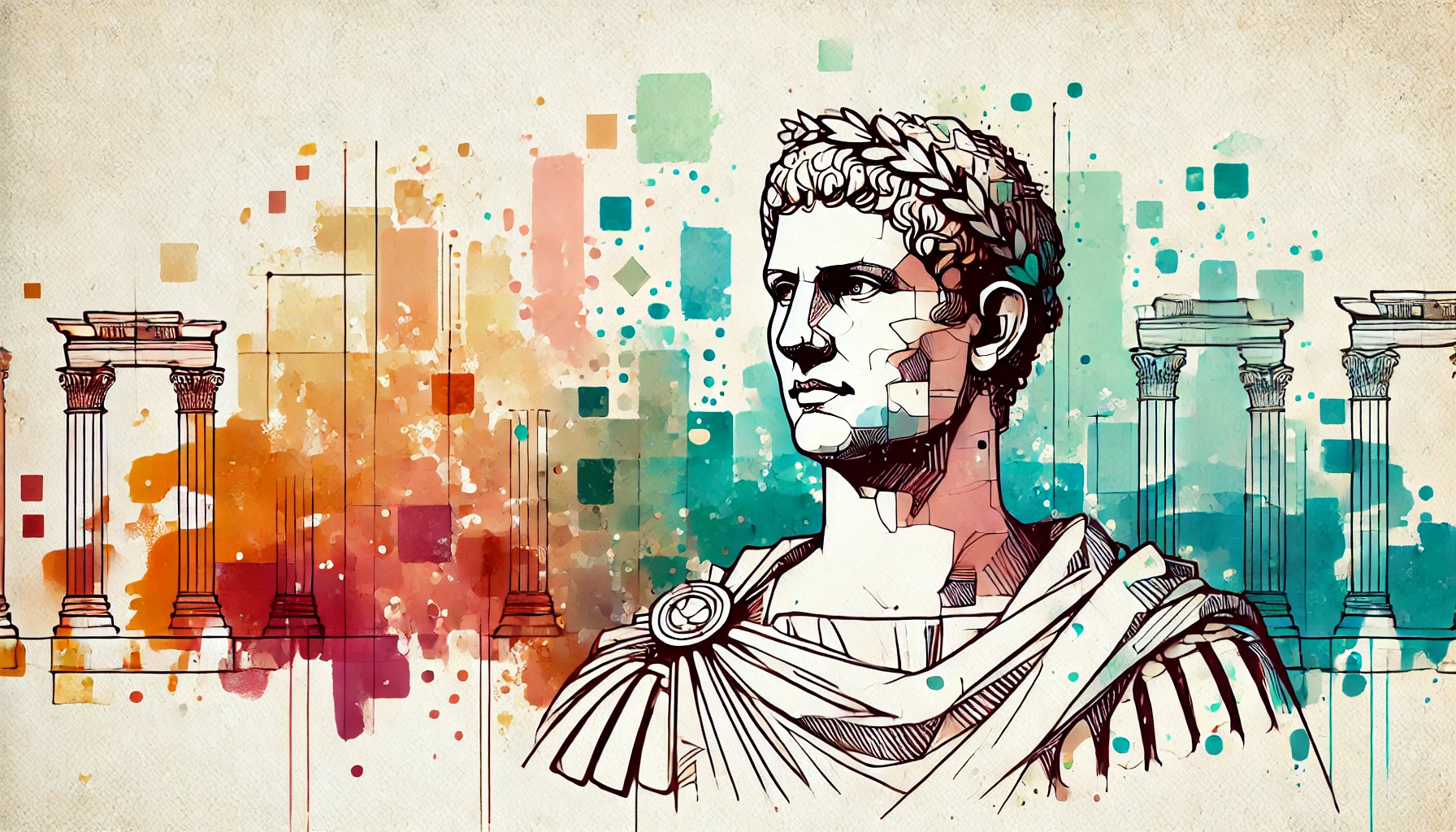
42 BCE: Birth of Tiberius, Second Emperor of Rome
On November 16, 42 BCE, Tiberius, who would become the second Emperor of Rome, was born. Known for his complex and sometimes reclusive rule, Tiberius’s reign was marked by military success and political intrigue.
The art of government is not to rule by fear, but to inspire respect by reason.
~ Tiberius
This quote reflects Tiberius’s belief in leadership through wisdom rather than fear, emphasizing respect over intimidation.
In silence and solitude, a ruler finds clarity unknown to those lost in the noise of the court.
~ Tiberius
Tiberius valued solitude, finding that it allowed him to make clear decisions without the distractions of court politics.
The glory of Rome is built not on conquest alone but on the wisdom to preserve what we have.
~ Tiberius
Tiberius saw Rome’s strength not only in expansion but also in the careful preservation of its achievements and stability.
Power is a fleeting gift; it must be held carefully, lest it slip away.
~ Tiberius
Here, Tiberius acknowledges the impermanent nature of power and the need for cautious, deliberate use of authority.
A ruler’s burden is to see farther than his people, even if he must walk alone.
~ Tiberius
This quote speaks to Tiberius’s understanding of leadership as a solitary journey requiring foresight.
True power comes not from command but from understanding.
~ Tiberius
Tiberius believed that empathy and comprehension of others’ needs and motives were essential aspects of true power.
The greatest threat to any empire is not the enemy beyond its borders, but the complacency within.
~ Tiberius
He viewed internal complacency as more dangerous than any foreign threat, recognizing that strength starts from within.
Patience is the ruler’s best ally, for in waiting, one finds the true measure of a man.
~ Tiberius
Tiberius emphasized patience as a virtue, suggesting that the best decisions often require careful timing.
In every decision, consider not only today but the many tomorrows that will bear its weight.
~ Tiberius
This quote highlights his belief in long-term thinking and the lasting impacts of a ruler’s choices.
A leader must sometimes walk alone, for the path to wisdom is not always popular.
~ Tiberius
Tiberius accepted that wise decisions might lead to isolation, as they are not always understood or embraced by others.
Unusual Facts:
- Tiberius was known for his reclusive nature and spent the last years of his reign in self-imposed exile on the island of Capri.
- He reluctantly accepted the title of emperor, feeling pressured by his mother, Livia, to take on the role.
- Tiberius had a deep fascination with astrology and often consulted astrologers.
- He was the first Roman emperor to face significant political opposition from the Senate.
- Despite his reputation as a cold ruler, Tiberius significantly improved the Roman Empire’s financial stability.
1532: Francisco Pizarro Captures Inca Emperor Atahualpa
On November 16, 1532, Spanish conquistador Francisco Pizarro captured Atahualpa, the emperor of the Inca Empire, at the Battle of Cajamarca. This event marked the beginning of the end for the Incan civilization.
1776: British Troops Capture Fort Washington
On November 16, 1776, British and Hessian forces captured Fort Washington in New York from the Continental Army. This significant defeat led to high American casualties and a major setback in the Revolutionary War.
Though Fort Washington falls, the resolve for liberty grows stronger with each blow struck upon us.
~ General George Washington
Washington believed that the spirit of the American cause would endure despite the challenges, viewing each loss as a step toward ultimate freedom.
1849: Fyodor Dostoevsky Sentenced to Death (Later Commuted)
On November 16, 1849, Russian author Fyodor Dostoevsky was sentenced to death for his involvement in a revolutionary political group. His sentence was later commuted to exile, an experience that deeply influenced his future writings.
To have known the depths of despair is to better understand the heights of redemption.
~ Fyodor Dostoevsky
Dostoevsky’s personal encounter with near execution instilled in him a profound perspective on human suffering and redemption, themes central to his novels.
1907: Oklahoma Becomes the 46th U.S. State
On November 16, 1907, Oklahoma was admitted as the 46th state of the United States. Known as the “Sooner State,” Oklahoma’s entry marked the end of the Indian Territory era and symbolized a blend of Native and settler cultures.
In this land, once promised and reclaimed, we forge our future from the spirit of pioneers and the heart of native peoples.
~ Oklahoma state historian
This quote reflects the state’s unique heritage and the resilience of its diverse communities in building a future together.
1938: First Synthesis of LSD
On November 16, 1938, Swiss chemist Albert Hofmann synthesized lysergic acid diethylamide (LSD) for the first time while working at Sandoz Laboratories. Although initially intended for medical research, LSD would later become central to 1960s counterculture.
The mind is a vast, unexplored universe, and in chemistry, we hold the key to unlocking its potential.
~ Albert Hofmann
Hofmann saw chemistry as a way to explore the mind, believing LSD offered new insights into human consciousness.
1945: Founding of UNESCO
On November 16, 1945, the United Nations Educational, Scientific and Cultural Organization (UNESCO) was founded in Paris. Its mission is to promote global peace and cooperation through education, science, and culture.
Peace must be founded upon knowledge, for ignorance is the true enemy of unity.
~ Julian Huxley, first Director-General of UNESCO
Huxley viewed education as the bedrock of peace, stressing that knowledge would be UNESCO’s weapon against global divisions.
1959: The Sound of Music Opens on Broadway
On November 16, 1959, the beloved musical The Sound of Music, created by Rodgers and Hammerstein, opened on Broadway. The musical’s touching story of family and resilience quickly became an American classic.
Music speaks to the heart and soul, a melody that binds family, history, and memory together.
~ Richard Rodgers
Rodgers expressed how music, through its timeless melodies, resonates deeply with people’s lives and histories.
1973: President Nixon Authorizes Construction of the Alaskan Pipeline
On November 16, 1973, U.S. President Richard Nixon signed the Trans-Alaska Pipeline Authorization Act, allowing the construction of the Alaskan Pipeline. This project boosted U.S. oil production and transformed Alaska’s economy.
This pipeline is not just steel and oil; it’s a lifeline to energy security and an investment in America’s future.
~ Richard Nixon
Nixon framed the pipeline as a crucial step toward U.S. energy independence, seeing it as a long-term asset for the nation.
1988: Benazir Bhutto Becomes Prime Minister of Pakistan
On November 16, 1988, Benazir Bhutto was elected Prime Minister of Pakistan, becoming the first woman to lead a Muslim-majority country. Her leadership marked progress for women’s rights and democracy in Pakistan.
We must shape a world where women can lead with pride, not just as daughters and wives, but as voices of their own destiny.
~ Benazir Bhutto
Bhutto’s words emphasize her vision of empowering women to take active, independent roles in society and politics.
Leave a Reply
You must be logged in to post a comment.