
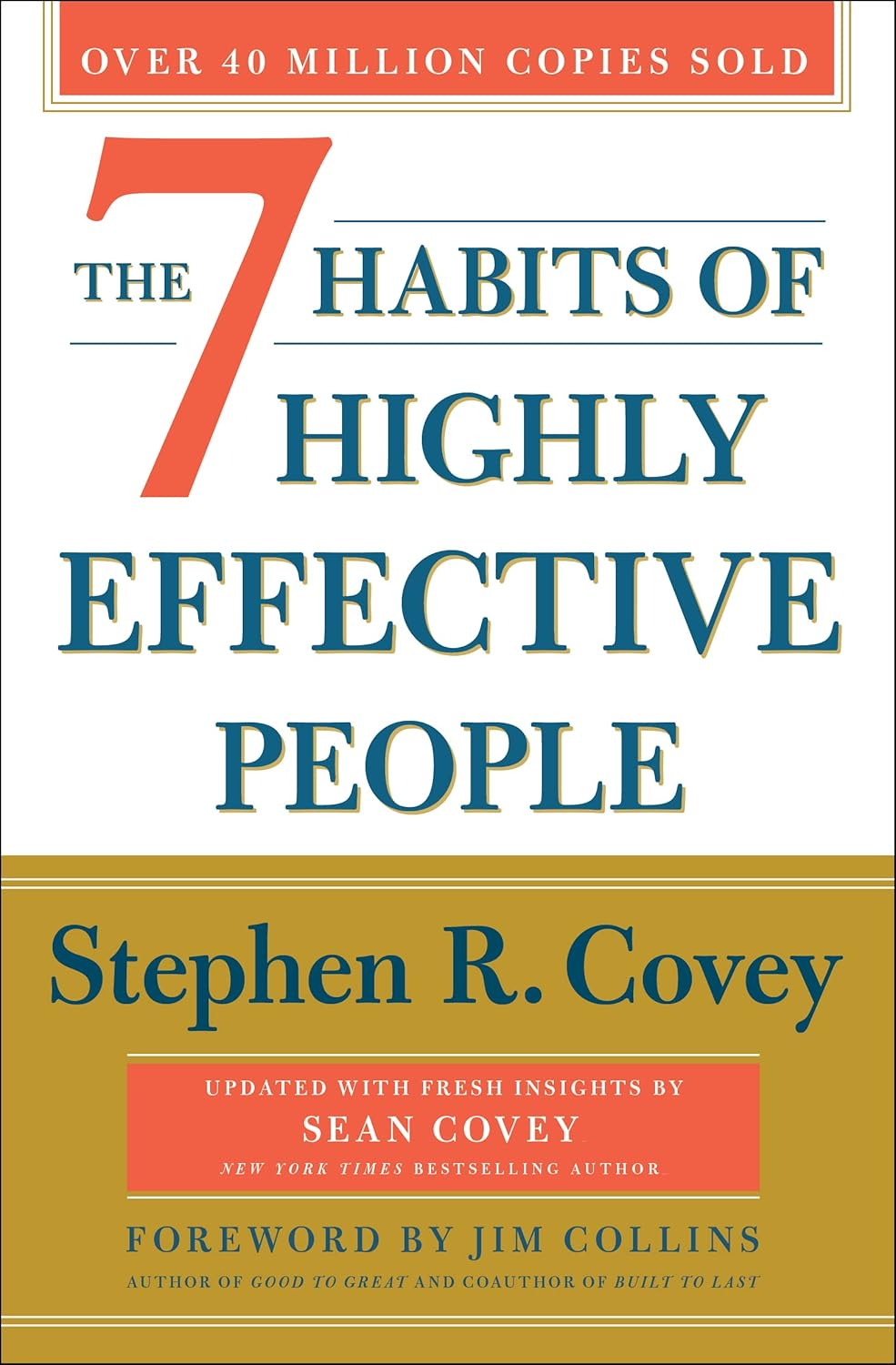
The 7 Habits of Highly Effective People, by Stephen R. Covey – 2000-word book summary
Overview
Stephen R. Covey’s The 7 Habits of Highly Effective People is one of the most influential self-development books ever written. First published in 1989, it distills timeless principles of character, leadership, and personal responsibility into seven habits that empower people to achieve effectiveness in every area of life.
Covey’s central message is that true success flows from character ethics—integrity, humility, courage, and service—not from quick-fix personality tricks. He teaches that effectiveness is the balance between production (what we achieve) and production capability (our ability to achieve it again).
“The way we see the problem is the problem.”
~ Stephen R. Covey
By changing how we perceive and act—our paradigms and habits—we can transform our relationships, our work, and our sense of purpose.
1. The Foundation: Inside-Out Change
Covey begins by contrasting two approaches to success:
- Personality ethic: focuses on external techniques—image, skills, and influence.
- Character ethic: focuses on inner principles—honesty, responsibility, and values.
He argues that sustainable success is inside-out. You must first win the private victory—mastering yourself—before you can win the public victory—working effectively with others.
“Private victories precede public victories. You can’t lead others until you’ve learned to lead yourself.”
~ Stephen R. Covey
Habits are the intersection of knowledge (what to do), skill (how to do), and desire (want to do). Developing all three creates lasting change.
2. Habit 1 – Be Proactive
Effectiveness begins with responsibility—the ability to choose your response. Covey calls this response-ability.
Reactive people are driven by circumstances, emotions, and conditions. Proactive people act based on values, not moods. They focus on what they can control rather than what they can’t.
Covey visualizes this through two circles:
- The Circle of Concern contains things you worry about but can’t control.
- The Circle of Influence contains what you can affect directly.
By focusing on the latter, your influence grows.
“Between stimulus and response, there is a space. In that space lies our freedom and power to choose our response.”
~ Stephen R. Covey
Practical takeaway: Replace reactive language (“I can’t,” “He makes me mad”) with proactive language (“I choose,” “I prefer,” “I will”). Responsibility is the foundation of personal leadership.
3. Habit 2 – Begin with the End in Mind
This habit is about vision and purpose. Everything is created twice: first mentally, then physically. You must know where you’re going before you begin the journey.
Covey encourages creating a personal mission statement—a written declaration of your deepest values and long-term goals. It guides decisions, clarifies priorities, and aligns daily actions with higher principles.
“If the ladder is not leaning against the right wall, every step we take just gets us to the wrong place faster.”
~ Stephen R. Covey
Practical takeaway: Visualize your ideal life and legacy. Imagine attending your own funeral—what do you want others to say about you? That vision becomes your compass.
4. Habit 3 – Put First Things First
Habit 3 turns vision into discipline. It’s about time management and prioritization—organizing your life around what matters most.
Covey introduces the Time Management Matrix, which divides activities into four quadrants:
- Important & Urgent – crises and deadlines.
- Important & Not Urgent – planning, relationships, personal growth.
- Not Important & Urgent – interruptions and distractions.
- Not Important & Not Urgent – trivial time-wasters.
Highly effective people live primarily in Quadrant II—important but not urgent activities that prevent crises and build long-term success.
“The key is not to prioritize what’s on your schedule, but to schedule your priorities.”
~ Stephen R. Covey
Practical takeaway: Plan each week around roles and goals, not tasks. Say no to anything that doesn’t serve your mission or values.
The First Three Habits: The Private Victory
Habits 1–3 focus on self-mastery. They move you from dependence to independence—from being reactive to proactive, from drifting to leading your life consciously. Once you achieve this private victory, you’re ready for the public victory: working effectively with others.
5. Habit 4 – Think Win-Win
Win-Win is the habit of mutual benefit—the belief that life is not a zero-sum game. It’s rooted in the abundance mindset, the idea that there’s enough success, love, and opportunity for everyone.
“Win-Win is a frame of mind and heart that constantly seeks mutual benefit in all human interactions.”
~ Stephen R. Covey
Covey contrasts the main paradigms:
- Win-Lose: I must win; you must lose.
- Lose-Win: I give in to keep the peace.
- Lose-Lose: Mutual destruction.
- Win: Selfish success without collaboration.
- Win-Win or No Deal: We both benefit—or we walk away.
Practical takeaway: Approach negotiations and relationships with empathy and integrity. Seek solutions that strengthen all sides.
6. Habit 5 – Seek First to Understand, Then to Be Understood
This is the habit of empathic communication. Most people listen with the intent to reply, not to understand. Covey teaches empathetic listening—listening to truly grasp another person’s perspective before offering your own.
“Most people do not listen with the intent to understand; they listen with the intent to reply.”
~ Stephen R. Covey
By understanding first, you build trust and influence. Once people feel heard, they’re open to hearing you.
Practical takeaway: Replace “autobiographical responses” (“I know exactly how you feel”) with curious questions (“Can you tell me more about that?”). Listening deeply is an act of respect—and a source of insight.
7. Habit 6 – Synergize
Synergy means that the whole is greater than the sum of its parts. It’s the habit of creative cooperation—valuing differences to achieve results neither side could produce alone.
“Synergy is what happens when one plus one equals three—or more.”
~ Stephen R. Covey
It builds on the previous habits: being proactive, valuing mutual benefit, and listening with empathy. Instead of compromise (where both sides give something up), synergy finds a third alternative—a better solution that honors everyone’s needs.
Practical takeaway: View disagreements as opportunities to learn. Ask, “Is there a third way that’s better than either of us imagined?”
The Next Three Habits: The Public Victory
Habits 4–6 build on personal mastery to create interdependence—the ability to work well with others. They transform competition into collaboration, replacing scarcity thinking with shared success.
8. Habit 7 – Sharpen the Saw
The final habit is about renewal—preserving and enhancing your greatest asset: yourself. Covey compares life to sawing wood. If you never stop to sharpen the saw, you become less effective over time.
Renewal must occur in four key dimensions:
- Physical – exercise, nutrition, rest.
- Mental – reading, learning, critical thinking.
- Social/Emotional – relationships, service, empathy.
- Spiritual – reflection, purpose, inner peace.
“We must never become too busy sawing to take time to sharpen the saw.”
~ Stephen R. Covey
Practical takeaway: Schedule renewal activities weekly. They’re not luxuries—they’re investments that sustain effectiveness in all other areas.
The Seventh Habit: Continuous Growth
Habit 7 reinforces all the others. It’s the habit of self-maintenance and continuous improvement. By regularly renewing yourself, you remain balanced, creative, and resilient. Covey calls this the upward spiral—constant learning, committing, and doing better each time.
“To keep progressing, you must learn, commit, and do—over and over again.”
~ Stephen R. Covey
9. The Three Levels of Maturity
Covey explains that personal growth passes through three stages:
- Dependence – relying on others (“You take care of me”).
- Independence – taking responsibility (“I can do it”).
- Interdependence – cooperating with others (“We can do it together”).
Effectiveness lies in the third stage—where independence meets collaboration. The 7 Habits guide this evolution:
- Habits 1–3 → Independence
- Habits 4–6 → Interdependence
- Habit 7 → Continuous renewal
“Interdependence is a choice only independent people can make.”
~ Stephen R. Covey
10. The Character Ethic in Action
Covey’s principles echo timeless virtues found in philosophy, religion, and psychology: integrity, fairness, courage, and humility. He contrasts personality quick fixes with principle-centered living, which endures because it’s rooted in universal laws rather than temporary tactics.
“Principles are not values. A gang can have values, but principles are the laws of the universe that never change.”
~ Stephen R. Covey
By aligning behavior with principles—justice, honesty, service—you build trust, the foundation of every effective relationship.
11. Applying the 7 Habits in Life and Work
Covey demonstrates how these habits apply to leadership, parenting, and organizations.
- In leadership: Effective leaders are proactive, mission-driven, and empathetic. They build Win-Win cultures and empower teams.
- In family life: Begin with the end in mind—raise children guided by shared values. Listen before lecturing. Celebrate differences.
- In organizations: Collective synergy emerges when individuals live by shared principles rather than control or fear.
“Trust is the highest form of human motivation. It brings out the very best in people.”
~ Stephen R. Covey
Effectiveness in any field flows from aligning personal mastery with collective purpose.
12. The Eighth Habit (Beyond the Original Seven)
Though Covey introduced it in a later book, The 8th Habit, its spirit is implicit here: find your voice and inspire others to find theirs. It’s the natural extension of the 7 Habits—living not just effectively but meaningfully, helping others awaken their potential.
“Find your voice and inspire others to find theirs.”
~ Stephen R. Covey
Key Takeaways
- Be Proactive – Take responsibility for your reactions and choices.
- Begin with the End in Mind – Define your purpose and long-term vision.
- Put First Things First – Prioritize what truly matters.
- Think Win-Win – Seek mutual benefit in relationships.
- Seek First to Understand, Then to Be Understood – Practice empathy before persuasion.
- Synergize – Value differences to create better solutions.
- Sharpen the Saw – Continually renew body, mind, heart, and spirit.
Final Reflection
The 7 Habits of Highly Effective People remains a classic because it teaches effectiveness as a way of being, not a set of tactics. Covey’s habits align character, relationships, and purpose into one coherent philosophy: to live intentionally, serve others, and grow continually.
“To change ourselves effectively, we first have to change our perceptions.”
~ Stephen R. Covey
The essence of Covey’s wisdom is simple yet profound: if you live by timeless principles, effectiveness—and peace—follow naturally.
Old summary:
Introduction: Principles and Character Ethics
Stephen R. Covey begins his influential book by explaining the foundation of the 7 Habits. Unlike quick-fix solutions, his approach is based on principles of character ethics, focusing on integrity, fairness, and human dignity. Covey argues that true success stems from aligning with these timeless principles, leading to personal and interpersonal effectiveness.
The way we see the problem is the problem.
~ Stephen R. Covey
Habit 1: Be Proactive
Covey’s first habit emphasizes taking responsibility for your life and actions. Being proactive means focusing on what you can control and influence rather than reacting to external circumstances. Proactive individuals act based on values rather than emotions, empowering them to shape their own destiny.
I am not a product of my circumstances. I am a product of my decisions.
~ Stephen R. Covey
Habit 2: Begin with the End in Mind
Habit 2 encourages readers to define their vision and purpose in life. Covey emphasizes the importance of creating a personal mission statement, which serves as a guiding framework for decision-making. By visualizing your desired outcomes, you can align your daily actions with long-term goals.
Begin with the end in mind. Start with a clear understanding of your destination.
~ Stephen R. Covey
Habit 3: Put First Things First
This habit focuses on prioritization and time management. Covey introduces the Time Management Matrix, which categorizes tasks into four quadrants based on urgency and importance. Effective people prioritize Quadrant II activities—important but not urgent—such as planning, building relationships, and personal development.
The key is not to prioritize what’s on your schedule, but to schedule your priorities.
~ Stephen R. Covey
Habit 4: Think Win-Win
Covey advocates for a mindset of mutual benefit in relationships and negotiations. A win-win approach fosters collaboration and trust by seeking solutions where all parties feel valued and satisfied. This habit is rooted in an abundance mentality, believing there’s enough success for everyone.
Win-win is a frame of mind and heart that constantly seeks mutual benefit in all human interactions.
~ Stephen R. Covey
Habit 5: Seek First to Understand, Then to Be Understood
This habit focuses on empathetic communication. Covey argues that most people listen with the intent to reply rather than to understand. By truly understanding others’ perspectives and emotions, you can build stronger connections and resolve conflicts more effectively.
Most people do not listen with the intent to understand; they listen with the intent to reply.
~ Stephen R. Covey
Habit 6: Synergize
Synergy involves leveraging the strengths and perspectives of others to create outcomes greater than what individuals could achieve alone. Covey explains that valuing diversity and fostering teamwork leads to innovation and mutual growth. Synergy is the culmination of habits 4 and 5 in action.
Synergy is the highest activity of life; it creates new untapped alternatives; it values and exploits the mental, emotional, and psychological differences between people.
~ Stephen R. Covey
Habit 7: Sharpen the Saw
The final habit focuses on self-renewal and maintaining balance across four dimensions: physical, mental, emotional/social, and spiritual. Covey emphasizes the importance of regularly investing in self-care and personal growth to sustain long-term effectiveness.
We must never become too busy sawing to take time to sharpen the saw.
~ Stephen R. Covey
Conclusion: A Journey Toward Effectiveness
Covey concludes by reminding readers that implementing the 7 Habits is a lifelong journey. These principles require consistent effort and reflection but offer profound rewards in personal and professional life. By living these habits, individuals can achieve greater fulfillment, effectiveness, and positive influence.
Between stimulus and response, there is a space. In that space lies our freedom and power to choose our response.
~ Stephen R. Covey
This summary highlights the core principles of The 7 Habits of Highly Effective People, offering actionable insights for personal and interpersonal growth. Let me know if there’s anything else you’d like explored!
Leave a Reply
You must be logged in to post a comment.