
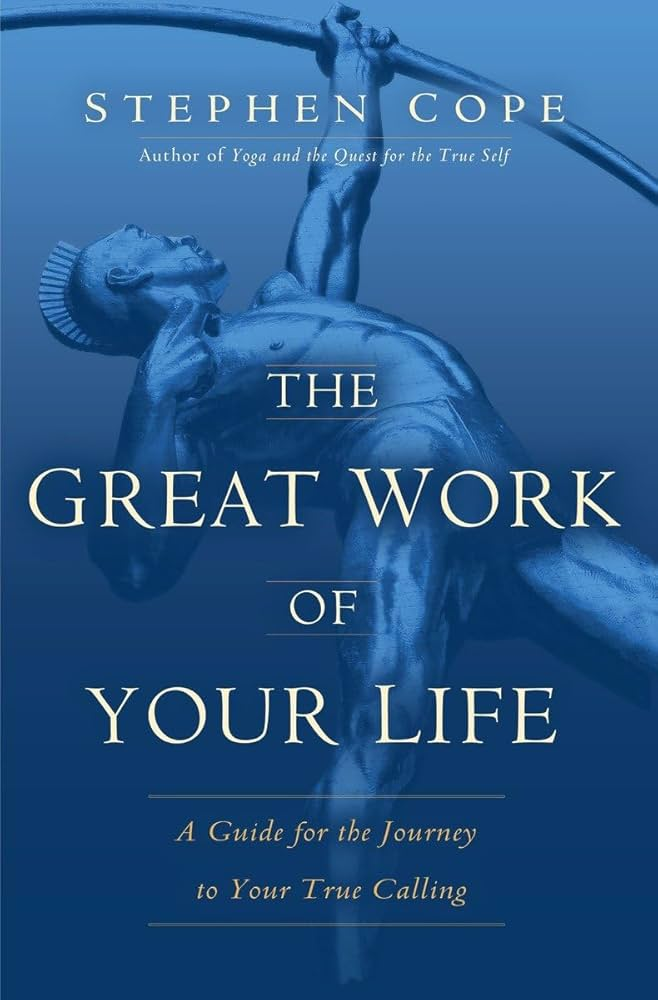
(Summary follows the book’s real structure, with verified quotes.)
Stephen Cope explores how people discover and live their true calling — their dharma — using lessons from the Bhagavad Gita and stories of artists, activists, athletes, and ordinary people. The book argues that purpose emerges when you commit fully to the work your life is uniquely asking of you.
Prelude — The Call to Dharma
Cope introduces the idea that every person has a unique contribution they are meant to make.
Dharma is not career or ambition — it is alignment with your deepest abilities and values.
“The world is waiting for you — yes, you — to express your dharma.” ~ Stephen Cope
Purpose is found not by searching endlessly, but by acting with clarity and honesty.
Chapter 1 — Find Your True Calling
Purpose is discovered at the intersection of talent, passion, and usefulness.
Cope shows how people miss their calling by trying to fit expectations or copy others.
“You cannot fail at your own dharma. You can only fail by trying someone else’s.” ~ Stephen Cope
The first step is to notice what truly energizes and compels you.
Chapter 2 — Do It Full Out
Once you have a sense of your calling, commitment is required.
Half-heartedness guarantees stagnation; wholehearted effort reveals the next steps.
“Give yourself wholeheartedly to your calling, whatever it is.” ~ Stephen Cope
Clarity grows from immersion, not hesitation.
Chapter 3 — Let Go of the Outcome
This principle, drawn from the Bhagavad Gita, teaches that you are responsible for the work, not the results.
Obsession with success destroys purpose.
“You have a right to your actions, but not to the fruits of your actions.” ~ Bhagavad Gita (quoted in the book)
Freedom and power come from focusing on the process.
Chapter 4 — Find the Right Container
Great work often requires supportive environments: communities, teachers, mentors, or chosen constraints.
The right setting nurtures your dharma; the wrong one stifles it.
“We need the right container to hold the fire of our dharma.” ~ Stephen Cope
Purpose is not pursued alone — it grows through connection.
Chapter 5 — Walk Your Path with Courage
Fear, comparison, and doubt appear on every purposeful path.
Cope argues that courage is not confidence — it is willingness.
“Most of us never meet our true lives because we are too afraid to step toward them.” ~ Stephen Cope
Every step taken in fear strengthens purpose.
Chapter 6 — The Skill of Nonattachment
Cope returns to the idea that clinging — to approval, identity, or status — shrinks your capacity for purpose.
You do the work because it’s yours to do, not because it guarantees reward.
“Nonattachment is not indifference. It is full-hearted engagement without clinging.” ~ Stephen Cope
This paradox unlocks creativity and peace.
Chapter 7 — Your Dharma and the World
Purpose is ultimately relational — it benefits others.
Your calling expands beyond personal fulfillment into service.
“When you follow your dharma, you serve the world in the exact way the world needs.” ~ Stephen Cope
A purpose that ends with the self is incomplete.
Core Lesson
Your purpose is already present within you — in your gifts, your longings, your struggles, and your responsibilities.
It is revealed not through endless analysis but through courageous action, sustained commitment, and inward honesty.
When you align with your dharma, you become fully alive — and you give the world the gift it was waiting for.
Leave a Reply
You must be logged in to post a comment.