
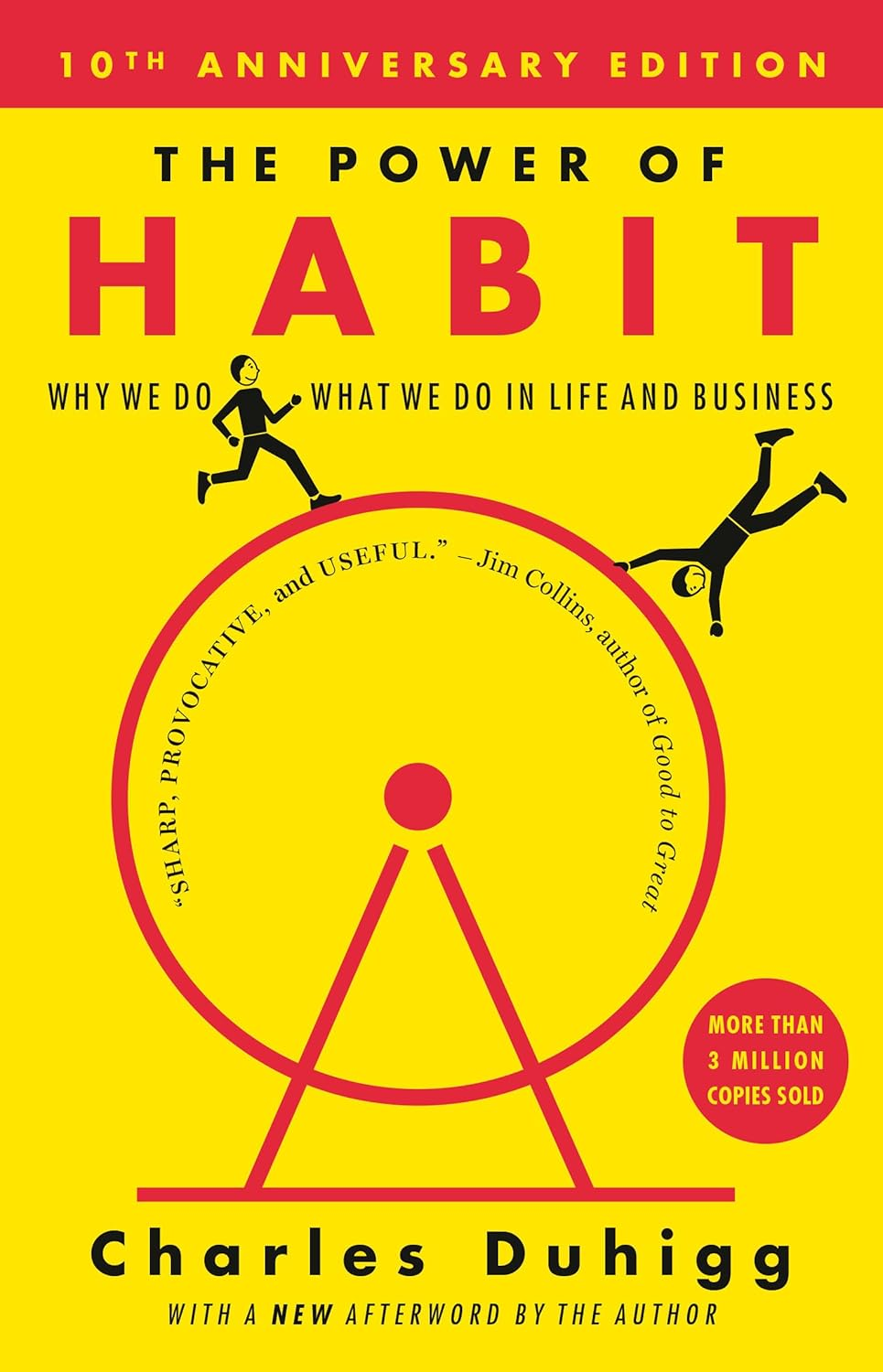

The Power of Habit: Why We Do What We Do in Life and Business, by Charles Duhigg – 2000-word book summary
Overview
In The Power of Habit, Pulitzer Prize–winning journalist Charles Duhigg explores the science of how habits work—why they exist, how they shape everything we do, and how we can change them. Drawing from neuroscience, psychology, and business case studies, he reveals that habits are not destiny; they’re mechanisms we can reprogram once we understand their structure.
The central insight: every habit follows a simple pattern called the habit loop—cue, routine, reward. By identifying and altering the elements of this loop, individuals, companies, and societies can change their behaviors at a fundamental level.
“The difference between who you are and who you want to be is what you do repeatedly.”
~ Charles Duhigg
1. The Habit Loop: Cue, Routine, Reward
Duhigg explains that all habits share a neurological pattern known as the habit loop:
- Cue – a trigger that tells your brain to go into automatic mode.
- Routine – the behavior or action that follows.
- Reward – the payoff that reinforces the behavior.
Over time, the brain begins to anticipate the reward whenever it senses the cue, creating a powerful craving that drives the routine.
“When a habit emerges, the brain stops fully participating in decision-making. It conserves effort, and unless you deliberately fight it, the pattern will unfold automatically.”
~ Charles Duhigg
Understanding this loop allows you to identify and modify your habits rather than being controlled by them.
2. How Habits Are Formed in the Brain
Neuroscientists at MIT discovered that habits are stored in a part of the brain called the basal ganglia, which controls automatic behaviors. Once a pattern is established, the brain can run it with minimal effort.
This efficiency frees mental energy for other tasks—but it also means that bad habits, once formed, become deeply ingrained.
“Habits never really disappear. They’re encoded in the structures of our brain. The only way to change them is to replace them.”
~ Charles Duhigg
This explains why relapses occur: under stress, the brain reverts to old patterns unless new ones are consciously reinforced.
3. The Golden Rule of Habit Change
You can’t erase a habit—but you can change its routine while keeping the cue and reward the same.
Duhigg calls this the Golden Rule of Habit Change:
Keep the cue. Keep the reward. Change the routine.
For example, if you snack every afternoon because you’re bored, the cue (time of day) and reward (mental break) remain—but you can replace the routine (eating junk food) with a short walk or conversation.
“To change a habit, you must keep the old cue, deliver the old reward, but insert a new routine.”
~ Charles Duhigg
This process works because you’re not trying to break your brain’s craving loop—you’re redirecting it.
4. Keystone Habits: The Habits That Matter Most
Not all habits are equal. Keystone habits are small behaviors that trigger a cascade of positive changes across multiple areas of life.
For instance:
- Exercise often leads to better eating and improved productivity.
- Making your bed can increase order and calm throughout the day.
- Tracking expenses leads to better financial decisions.
“Keystone habits start a process that, over time, transforms everything.”
~ Charles Duhigg
These habits create momentum because they reshape your self-image: if I can do this, I can do more.
5. Craving: The Engine That Drives Habits
At the heart of every habit is craving—the anticipation of the reward, not the reward itself.
Duhigg gives the example of how marketing transformed toothpaste and cigarettes into mass-consumption products by creating cravings. Advertisers learned to link their products to powerful sensations (the tingle of toothpaste, the relaxation of a smoke).
“Cravings are what drive habits. Figuring out how to spark a craving makes creating a new habit easier.”
~ Charles Duhigg
The brain begins to expect satisfaction before it arrives. This anticipation is what makes habits so hard to resist—and so powerful when harnessed.
6. The Power of Belief
Duhigg emphasizes that true habit change often requires belief—especially in difficult moments. Without belief, old patterns return under stress.
This belief is often created through community. Support groups like Alcoholics Anonymous succeed not just because they replace routines (drinking with meetings), but because they give members faith in something bigger than themselves.
“Change happens among other people. Belief is easier when it’s shared.”
~ Charles Duhigg
This insight applies to all forms of habit change: transformation sticks when you believe you can change—and have others who believe it too.
7. Individual Habits: How to Change Your Own
Duhigg outlines a practical framework for personal habit change:
- Identify the routine. What’s the behavior you want to change?
- Experiment with rewards. What craving is it satisfying—comfort, stimulation, connection?
- Isolate the cue. Is it triggered by location, time, emotion, people, or a preceding action?
- Plan a new routine. Keep the same cue and reward, but replace the behavior.
“Once you understand your habit loop—once you diagnose the cue, the routine, and the reward—you can begin to change it.”
~ Charles Duhigg
Awareness and experimentation turn unconscious patterns into deliberate choices.
8. Organizational Habits: How Companies Use Habits
Duhigg extends the science of habits to organizations, showing how corporate culture operates through collective patterns of behavior.
Example 1: Paul O’Neill at Alcoa
When Paul O’Neill became CEO of Alcoa, he didn’t focus on profits—he focused on worker safety. This single keystone habit transformed the company. By changing safety routines, he improved communication, accountability, and efficiency, leading to record profits.
“If you focus on changing one thing, you can set off a chain reaction that changes everything.”
~ Charles Duhigg
Example 2: Starbucks and Willpower Training
Starbucks trains employees to handle stressful situations by rehearsing specific routines—turning willpower into a habit. When challenges arise, employees respond automatically with calm professionalism.
These examples show that organizations, like individuals, thrive when they identify and reinforce key behavioral loops.
9. Social Habits: How Movements Happen
Habits don’t just shape individuals—they drive social change. Duhigg illustrates this through historical movements, such as the Montgomery Bus Boycott led by Rosa Parks and Martin Luther King Jr.
Three stages explain how social habits spread:
- Friendship and social ties ignite initial participation.
- Community networks turn small acts into movements.
- New habits of identity sustain the movement beyond one event.
“Movements don’t emerge because everyone suddenly decides to care. They happen because social habits of friendship and community keep people connected long enough to act together.”
~ Charles Duhigg
The same principles apply to modern social movements and corporate cultures—lasting change is built on habitual relationships and shared belief.
10. The Neurology of Free Will
The final section examines the deeper question: Are habits choices, or are we prisoners of them?
Duhigg explores cases like that of a man named Eugene, whose memory loss caused him to repeat behaviors without conscious thought. His brain couldn’t form new memories, yet his old habits remained intact.
This shows that habits operate below awareness—but awareness allows us to reclaim control.
“Once you know a habit exists, you have the responsibility to deal with it.”
~ Charles Duhigg
Habits define much of our behavior, but they don’t define our destiny. The ability to recognize and reshape them is what makes us human.
11. The Science of Willpower
Willpower, Duhigg argues, is a habit, not a virtue. It can be trained through deliberate practice and reinforced by supportive environments.
Studies show that people who make small, consistent commitments—like tracking spending or planning meals—build “willpower muscles” that carry over to other areas of life.
“Willpower isn’t just a skill. It’s a habit that spreads to everything else you do.”
~ Charles Duhigg
By treating discipline as a habit loop—cue (temptation), routine (pause and reflect), reward (self-respect)—we can strengthen self-control through repetition.
12. Keystone Habits in Business and Life
Keystone habits apply everywhere. Duhigg gives more examples:
- Exercise increases energy and confidence, leading to healthier eating.
- Family dinners improve communication and academic performance in children.
- Journaling enhances emotional regulation and creativity.
“Some habits have the power to start a chain reaction, changing every part of your life.”
~ Charles Duhigg
By identifying a single keystone habit and mastering it, you can initiate broad, positive transformation.
13. Small Wins: The Building Blocks of Big Change
Duhigg emphasizes the power of small wins—manageable, visible successes that create momentum. Each small victory reinforces belief and encourages further effort.
“Small wins fuel transformative changes by building momentum.”
~ Charles Duhigg
This principle explains why programs like AA focus on “one day at a time,” and why successful companies celebrate minor improvements. Change grows through accumulated confidence, not radical overhaul.
14. The Habit of Hope
Duhigg concludes that habit change ultimately depends on hope—the belief that transformation is possible.
“Change might not be fast, and it isn’t always easy. But with time and effort, almost any habit can be reshaped.”
~ Charles Duhigg
Hope fuels persistence, and persistence reshapes identity. Over time, habits evolve into character—the sum of our repeated choices.
Key Takeaways
- Habits run on loops: cue → routine → reward.
- Identify and alter the loop to change behavior.
- You can’t erase a habit, but you can replace it.
- Keystone habits trigger positive ripple effects.
- Craving drives habits; anticipate and redirect it.
- Belief—especially shared belief—makes change stick.
- Willpower is a trainable habit, not an innate trait.
- Small wins compound into major transformations.
- Awareness gives control. You’re responsible for the habits you keep.
Final Reflection
The Power of Habit reframes life as a network of patterns—most invisible, yet all malleable. The lesson is both humbling and empowering: your habits are not your fate. Once you understand the loops that run your life, you can rewrite them—turning unconscious behavior into conscious design.
“Once you’re aware that habits can change, you have the freedom—and the responsibility—to remake them.”
~ Charles Duhigg
The power of habit is not just in what you do, but in your ability to choose who you become.
Old summary:
Introduction: Understanding Habits and Their Power
The Power of Habit by Charles Duhigg explores the science of habit formation, illustrating how habits shape our lives, businesses, and societies. Duhigg explains how habits are created, changed, and leveraged to achieve personal and professional success. The book introduces the habit loop—cue, routine, and reward—as the foundation of behavior and offers strategies to reprogram habits for lasting transformation.
Habits aren’t destiny. They can be ignored, changed, or replaced. But it requires an understanding of how they work.
~ Charles Duhigg
Part 1: The Habit Loop – The Science Behind Habits
Duhigg introduces the concept of the habit loop, which explains how habits function:
- Cue – A trigger that initiates the behavior.
- Routine – The behavior itself.
- Reward – The benefit received, reinforcing the habit.
Duhigg emphasizes that habits are deeply rooted in the brain, allowing actions to be automatic and efficient. Understanding this loop is the first step to changing habits.
The Golden Rule of Habit Change: You can’t extinguish a bad habit; you can only change it.
~ Charles Duhigg
Part 2: How to Change Habits
The key to changing habits, Duhigg argues, lies in keeping the cue and reward the same but modifying the routine. This method makes change easier while preserving the neurological patterns of habit formation.
Cravings are what drive habits. And figuring out how to spark a craving makes creating a new habit easier.
~ Charles Duhigg
Key Lessons:
- Identify the cue, routine, and reward driving a habit.
- Replace the routine while maintaining the original cue and reward.
- Reinforce new habits with repeated practice.
Small wins are a steady application of a small advantage.
~ Charles Duhigg
Part 3: Keystone Habits – Creating Ripple Effects
Duhigg introduces the concept of keystone habits—core habits that trigger positive changes in other areas of life. Examples include exercising, meditating, and journaling. These habits build momentum for other beneficial behaviors.
Keystone habits start a process that, over time, transforms everything.
~ Charles Duhigg
Key Lessons:
- Focus on building one keystone habit to spark broader transformation.
- Use keystone habits as anchors to support bigger goals.
- Celebrate small wins to reinforce new behaviors.
If you believe you can change—if you make it a habit—the change becomes real.
~ Charles Duhigg
Part 4: Habits in Organizations and Companies
Duhigg explores how organizations and businesses use habits to influence behavior. He discusses companies like Starbucks and Target, which employ habit-based strategies to attract and retain customers.
Companies aren’t families. They’re battlefields in a civil war.
~ Charles Duhigg
Key Lessons:
- Successful organizations use habits to standardize processes and enhance efficiency.
- Leadership can reshape organizational habits by targeting keystone habits.
- Reward systems reinforce company culture and employee behavior.
The key to success is creating routines that become second nature.
~ Charles Duhigg
Part 5: Social Habits – Changing Communities
Duhigg explains how habits play a role in societal change. Movements like the Civil Rights Movement demonstrate how social habits and collective actions are driven by shared routines and rewards.
Small habits, when practiced by enough people, can create widespread change.
~ Charles Duhigg
Key Lessons:
- Societal habits are formed through repeated group behaviors.
- Social movements gain momentum through habit-based organization and commitment.
- Leaders influence change by appealing to shared values and reinforcing collective habits.
Social habits are why some movements grow, while others fail.
~ Charles Duhigg
Part 6: Willpower – The Habit of Success
Duhigg highlights the role of willpower as a muscle that can be strengthened through practice. He discusses experiments showing that self-discipline predicts success more reliably than intelligence or talent.
Willpower isn’t just a skill. It’s a muscle, and it gets stronger the more you use it.
~ Charles Duhigg
Key Lessons:
- Strengthen willpower by focusing on small, manageable tasks.
- Use routines to reduce decision fatigue and conserve mental energy.
- Plan for obstacles to reinforce self-control and persistence.
Once willpower becomes a habit, it can be deployed automatically in any situation.
~ Charles Duhigg
Practical Applications
Breaking Bad Habits
Duhigg emphasizes the importance of identifying triggers and rewards to reprogram harmful habits.
The easiest way to create a new habit is to tie it to a pre-existing routine.
~ Charles Duhigg
Building Good Habits
Focus on small, incremental changes to make habits stick.
Small changes compound into significant transformations over time.
~ Charles Duhigg
Harnessing Social Influence
Use group dynamics to reinforce habits and accountability.
The choices that make up your habits are what make you who you are.
~ Charles Duhigg
Key Takeaways
- Understand the Habit Loop – Analyze the cues, routines, and rewards driving your habits.
- Change the Routine – Keep the cue and reward but modify the behavior to create lasting change.
- Focus on Keystone Habits – Identify habits that trigger positive ripple effects in other areas of life.
- Strengthen Willpower – Treat willpower like a muscle that grows stronger with practice.
- Embrace Small Wins – Build momentum by celebrating minor victories to sustain motivation.
Conclusion: Transform Your Life with Habits
Charles Duhigg’s The Power of Habit demonstrates how understanding the science of habits can lead to personal, organizational, and societal transformation. By recognizing the cues and rewards that shape behavior, readers can intentionally design habits that drive success and happiness.
Habits are not destiny. They’re patterns we can shape to transform our lives.
~ Charles Duhigg
Leave a Reply
You must be logged in to post a comment.